


The following report was generated with Inferent Analyst’s agentic intelligence workflows. Subscribe to keep informed of this unique project.
Alphabet Inc. (NASDAQ: GOOG)
Q2 FY2026 Earnings Analysis
Report date, July 22, 2026 (results released after market close). Quarter ended June 30, 2026.
Performance highlights and quantitative comparison
Consolidated revenue of $119.8 billion increased approximately 24 percent year over year (23 percent in constant currency) and approximately 9.0 percent quarter over quarter, marking a 12th consecutive quarter of double digit revenue growth as cited by management.
GAAP operating income of $40.77 billion grew approximately 30 percent year over year and approximately 2.7 percent quarter over quarter. Operating margin expanded to 34 percent from 32 percent a year ago, though it compressed from 36.1 percent in the prior quarter.
GAAP diluted EPS of $9.11 increased approximately 294 percent year over year and approximately 78 percent quarter over quarter, driven overwhelmingly by a one time, non-operating $99.0 billion gain on equity securities. On a normalized, core basis (excluding the disclosed one-time equity gain impact), EPS was approximately $2.85, up approximately 23 percent year over year and approximately 3.3 percent quarter over quarter.
Google Cloud revenue of $24.8 billion grew approximately 82 percent year over year, a meaningful acceleration from 63 percent growth in the prior quarter, and Cloud segment operating margin improved to approximately 35.6 percent from approximately 32.9 percent in the prior quarter.
Free cash flow turned negative for the quarter at approximately negative $5.9 billion, a swing of roughly $16 billion from positive $10.1 billion in the prior quarter, as capital expenditures of $44.9 billion (up approximately 26 percent quarter over quarter and 100 percent year over year) outpaced operating cash flow of $39.1 billion. This may represent an emerging regime change in Alphabet’s cash generation profile as AI infrastructure investment scales.

*Adj. EPS and Net income rows are normalized to exclude the disclosed one-time equity securities gain impact for comparability with consensus estimates (see analyst notes above). GAAP figures were $9.11 EPS and $112,107M net income available to common stockholders for Q2 2026, and $5.11 EPS and $62,578M net income for Q1 2026.
Additional consensus metrics

**EBITDA is a derived estimate (operating income plus depreciation and amortization plus stock based compensation) since Alphabet does not report this metric directly.
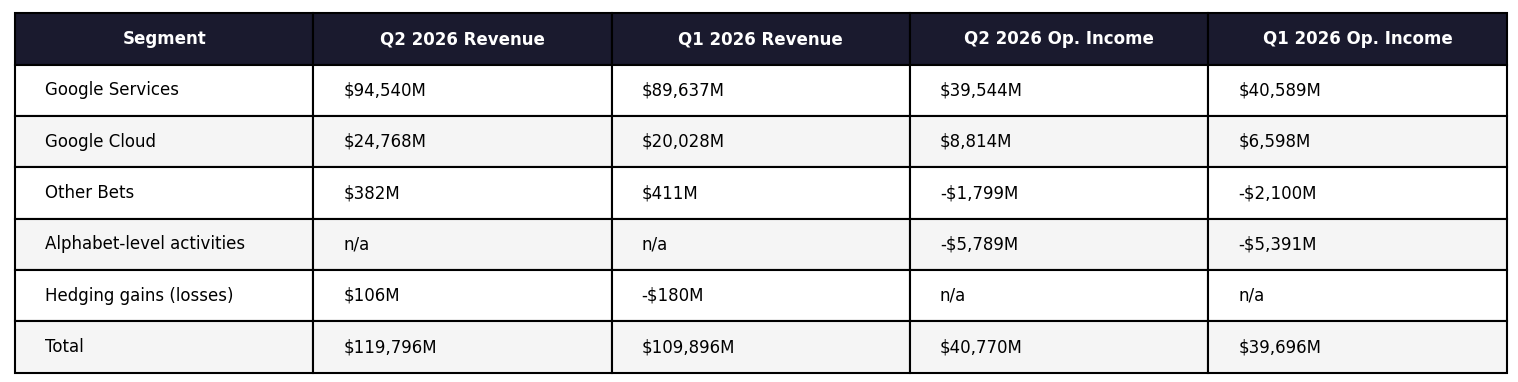
Segment revenues and operating income (EBIT)
Alphabet discloses three reportable segments: Google Services, Google Cloud, and Other Bets, with certain shared AI research and development and corporate costs held at the Alphabet level and not allocated to segments.
Key business drivers and segment observations
Google Services revenue grew approximately 15 percent year over year to $94.5 billion, roughly in line with 16 percent growth in the prior quarter. Within Services, Google Search and other grew approximately 17 percent year over year, a deceleration from approximately 19 percent in the prior quarter, a modest weak signal worth monitoring given Search remains the largest single revenue line.
YouTube advertising grew approximately 13 percent year over year, an acceleration from approximately 11 percent in the prior quarter, aided by elevated viewership tied to FIFA World Cup 2026 content, described by management as over 1.7 billion unique viewers, which may include a degree of event-driven, non-recurring demand.
Google subscriptions, platforms, and devices revenue grew approximately 15 percent year over year, decelerating from approximately 19 percent in the prior quarter.
Google Cloud operating income more than tripled year over year to $8.8 billion from $2.8 billion, and Cloud segment operating margin improved for a second consecutive quarter, suggesting increasing operating leverage in the Cloud business even as capital intensity rises.
Other Bets operating losses narrowed quarter over quarter to negative $1.8 billion from negative $2.1 billion, though losses remain wider than the year ago quarter’s negative $1.2 billion.
Alphabet-level activities, which include shared AI research and development costs not allocated to segments, increased to negative $5.8 billion from negative $3.4 billion a year ago, an increase of approximately 72 percent year over year and the largest such cost base in the two-quarter comparison window. This concentration of unallocated AI research and development spend is a trend worth monitoring as it obscures segment-level margin visibility.
Research and development expense grew approximately 32 percent year over year and approximately 7.0 percent quarter over quarter to $18.2 billion. General and administrative expense increased approximately 50.6 percent quarter over quarter to $6.5 billion, a notably sharp sequential jump that the source materials do not explain in detail.
Total costs and expenses grew approximately 21 percent year over year and approximately 12.6 percent quarter over quarter, outpacing revenue growth on a sequential basis and contributing to the quarter over quarter operating margin compression noted above.
Cash flow, balance sheet, and capital allocation trends
Capital expenditures reached $44.9 billion in the quarter, up approximately 26 percent quarter over quarter and approximately 100 percent year over year, reflecting continued scaling of AI infrastructure and data center capacity.
Free cash flow was approximately negative $5.9 billion in Q2 2026, down from positive $10.1 billion in Q1 2026, positive $24.6 billion in Q4 2025, and positive $24.5 billion in Q3 2025. This four quarter trend shows a consistent deceleration culminating in negative free cash flow, which may represent an emerging regime change rather than a one quarter anomaly, and could warrant continued monitoring.
Long-term debt rose to $98.2 billion as of June 30, 2026 from $77.5 billion at March 31, 2026 and $46.5 billion at December 31, 2025, more than doubling over two quarters. The company issued senior unsecured notes for net proceeds of $20.3 billion in Q2 2026, following $31.1 billion in Q1 2026.
In June 2026, Alphabet raised approximately $49.6 billion in aggregate net proceeds through a combination of Class A and Class C common stock and, notably, its first mandatory convertible preferred stock issuance, explicitly earmarked to fund AI infrastructure and global compute capacity. This is a potential capital structure regime change for a company that has historically self funded growth investment from operating cash flow.
Share repurchases were zero in both Q1 2026 and Q2 2026, compared with $15.1 billion and $13.2 billion in the respective year ago quarters. Diluted share count rose slightly year over year to 12,309 million from 12,198 million, the first period in this comparison window without net share count reduction, a potential shift in capital return priorities toward funding capital expenditure over buybacks.
The company introduced a new preferred stock dividend of $12.15 per share (equivalent to approximately $0.60 per depositary share) alongside its existing common dividend, which was raised approximately 5 percent to $0.22 per share in the prior quarter and maintained at that level in Q2 2026.
Total cash, cash equivalents, and marketable securities increased sharply to $242.5 billion at quarter end from $126.8 billion at March 31, 2026, primarily reflecting the proceeds of the debt and equity capital raises rather than organic cash generation.
Summary assessment
Overall, Alphabet’s Q2 2026 results met consensus revenue expectations and modestly missed consensus on core operating income, core EPS, and core net income, with approximately 24 percent revenue growth and approximately 23 percent core EPS growth year over year. Growth appears to be accelerating at the segment level, particularly in Google Cloud, where revenue growth increased to approximately 82 percent from 63 percent, but consolidated core profitability growth may be decelerating on a sequential basis as unallocated AI research and development costs, general and administrative expense, and capital expenditures all grew faster than revenue quarter over quarter, and free cash flow turned negative for the first time in the comparison window.
Management discussion and analysis comparison
Management discussion, current quarter (Q2 2026)
CEO Sundar Pichai characterized Q2 2026 as “an amazing quarter,” citing consolidated revenue growth of 24 percent year over year and an acceleration in Google Cloud growth to 82 percent, which he attributed to demand for AI infrastructure and AI solutions. Management highlighted broad adoption of Gemini Enterprise, described as used by nearly 90 percent of the Fortune 100, alongside throughput of 22 billion Gemini API tokens per minute and 950 million monthly active users of the Gemini App. Commentary also emphasized new security offerings, including Gemini 3.5 Flash Cyber, and elevated YouTube engagement tied to FIFA World Cup 2026 coverage, with more than 1.7 billion unique viewers cited. Management framed the results as evidence that Alphabet’s “differentiated, full stack approach to AI is delivering real, measurable value for consumers, customers, and our partners globally,” a consistently optimistic and confidence-projecting tone throughout the release.
Management discussion, prior quarter (Q1 2026)
In the Q1 2026 release, management described 2026 as “off to a terrific start,” citing revenue growth of 22 percent and Google Cloud revenue growth of 63 percent, with Cloud backlog described as having “nearly doubled quarter on quarter to over $460 billion.” Management cited Search query growth at an all time high alongside AI experiences, the strongest quarter ever for consumer AI plans via the Gemini App, paid subscriptions reaching 350 million, 40 percent quarter over quarter growth in Gemini Enterprise paid monthly active users, and a Waymo milestone of surpassing 500,000 fully autonomous rides per week. The tone was similarly optimistic, framed around momentum entering the new fiscal year and described as “really exciting” for users, customers, and the business.
Sentiment scoring and comparison
Current quarter (Q2 2026) MD&A sentiment score: 17.8 out of 20, reflecting dense use of superlative language (”amazing,” “outstanding,” “exciting momentum across the board”), broad-based segment strength, and emphasis on accelerating Cloud growth and wide AI product adoption metrics.
Prior quarter (Q1 2026) MD&A sentiment score: 17.0 out of 20, also strongly optimistic (”terrific start,” “really exciting”) with multiple concrete momentum metrics (backlog growth, subscription counts, Waymo milestone), though marginally less superlative-dense than Q2 commentary.
Sentiment delta: plus 0.8 versus last quarter, indicating a modest further increase in management’s expressed optimism, concentrated around the Cloud acceleration and AI product adoption narrative.
Recurring themes across both quarters
AI investment described as the central growth driver across Search, Cloud, and consumer products.
References to a “full stack” AI approach spanning infrastructure, models, and applications.
Gemini model adoption metrics (API token throughput, Gemini App monthly active users) cited as evidence of AI traction.
Google Cloud growth acceleration and enterprise AI adoption (Gemini Enterprise) as a headline datapoint.
Consistently confident, momentum-oriented framing from the CEO in both quarters.
New or emerging themes in Q2 2026
Explicit reference to the quarter’s large capital raise (common and preferred equity, plus an at-the-market program) to fund AI infrastructure, a topic not present in the Q1 narrative.
Introduction of Gemini 3.5 Flash Cyber and increased emphasis on security solution demand.
Fortune 100 penetration statistic (nearly 90 percent) for Gemini Enterprise, a new specific adoption datapoint.
Event-driven YouTube viewership commentary tied to the FIFA World Cup, which may not recur in future quarters.
Themes present in Q1 2026 but absent from the Q2 2026 highlights
Specific Google Cloud backlog dollar figure (over $460 billion in Q1) was not repeated in the Q2 highlights excerpted here, though it may have been addressed on the earnings call, which was not part of the source documents reviewed.
Waymo autonomous ride milestone commentary, prominent in Q1, was not mentioned in the Q2 release highlights.
Specific paid subscription count (350 million in Q1) was not repeated in the Q2 release.
Tone shift assessment
Both quarters maintain a consistently optimistic, growth-affirming tone with limited direct acknowledgment of risk or caution in the excerpted management commentary.
The Q2 narrative places somewhat greater emphasis on scale and dominance signals (Fortune 100 adoption, token throughput, viewer counts) and, notably, on external capital raising activity, which could be read either as a sign of confidence in funding continued AI investment or as an early signal of rising capital intensity that investors may wish to monitor.
Compared to Q1, management’s tone in Q2 remained similarly upbeat but shifted emphasis toward capital formation and enterprise-scale AI adoption metrics, potentially reflecting the scale of investment required to sustain the Cloud growth acceleration, replacing the Q1 emphasis on specific operational momentum milestones such as Cloud backlog and Waymo ride volumes.
Guidance evaluation and consensus implications
Alphabet does not publish formal numerical revenue or EPS guidance ranges in its earnings press release for either the next quarter or the full year, consistent with its historical disclosure practice. Management midpoints in the table below are therefore marked as not formally provided, and the evaluation instead relies on consensus estimates and the implied growth rates they embed.

Implied growth calculations
Next quarter (Q3 2026) consensus revenue of $127,157M implies sequential growth of approximately 6.1% over Q2 2026 actual revenue of $119,796M (calculation, 127,157 divided by 119,796 minus 1).
Next quarter (Q3 2026) consensus EPS of $3.0933 implies sequential growth of approximately 8.5% over the normalized Q2 2026 core EPS of $2.85 (calculation, 3.0933 divided by 2.85 minus 1).
Full year 2026 consensus revenue of $502,006M less actual H1 2026 revenue of $229,692M implies consensus expects approximately $272,314M of revenue across Q3 and Q4 2026 combined, an average of approximately $136,157M per quarter, itself implying continued sequential growth beyond the Q3 consensus figure into Q4.
Prior year comparable revenue for Q3 2025 and Q4 2025 was not available within the four source documents supplied for this analysis, so a year over year growth rate implied by the next quarter and full year consensus figures could not be directly computed here and is flagged as a data gap rather than estimated from outside sources.
Assessment of likely analyst revision direction
Core operating income, core EPS, and core net income each came in modestly below consensus (approximately -2.3%, -3.5%, and -3.2% respectively), while revenue was essentially in line (-0.3%). This pattern, combined with a sharp swing to negative free cash flow and a substantial step-up in unallocated AI research and development and general and administrative costs, could modestly pressure near-term core EPS and EBIT estimates lower for some analysts.
Conversely, Google Cloud’s acceleration to 82% revenue growth from 63% in the prior quarter, together with improving Cloud segment operating margin, beat the pace of improvement embedded in the prior quarter’s trend and could support upward revisions to Cloud-specific revenue and long-term margin assumptions for other analysts.
Given the offsetting signals, the net direction of consensus revisions following this print is uncertain and could reasonably skew mixed to modestly negative on near-term core EPS, with any Cloud-driven upward revisions likely to be more visible in longer-dated estimates than in the immediate next quarter figure.
What is missing and emerging risk assessment
No formal revenue or EPS guidance was provided for Q3 2026 or full year 2026, consistent with Alphabet’s historical practice, though the market may still have been looking for updated full year capital expenditure guidance given the scale of the AI infrastructure buildout; the source documents reviewed do not contain an updated, specific full year capital expenditure dollar figure or range.
The Q1 2026 release prominently cited Google Cloud backlog (remaining performance obligations) at over $460 billion and nearly doubling quarter over quarter, a metric closely watched by investors as a leading indicator of the AI infrastructure demand cycle. This figure, or an updated equivalent, does not appear in the Q2 2026 press release highlights reviewed for this analysis, which may reflect only the scope of the two-page highlights excerpt rather than an actual omission from the full disclosure package, since the earnings call transcript was not among the source documents available.
The source materials provide limited explanation for the approximately 72% year over year increase in unallocated Alphabet-level activities costs and the approximately 50.6% sequential increase in general and administrative expense; investors may look for further detail on these cost drivers in the Form 10-Q or on the earnings call.
No specific update on regulatory or antitrust matters (including ongoing search-related remedies and other jurisdictional proceedings) appears in the press release highlights reviewed, an area that has been a material overhang for the stock and one the market may expect commentary on each quarter.
The Q1 2026 release cited a Waymo milestone of over 500,000 fully autonomous rides per week; no comparable autonomous vehicle or Other Bets operational update appears in the Q2 2026 highlights, despite Other Bets operating losses remaining a notable, if narrowing, drag on consolidated results.
Limited detail is provided on the strategic rationale for the shift toward external capital raising, including the company’s first ever preferred stock issuance and a new at-the-market common equity program, beyond a general statement that proceeds will fund AI infrastructure and compute capacity and meet tax obligations associated with employee equity grants; this represents a potential emerging change in capital structure philosophy that may warrant closer monitoring in subsequent quarters.
The pause in share repurchases across both quarters of 2026 to date, following consistent buyback activity in the year ago periods, was not explicitly addressed or explained in the management commentary reviewed.
Conclusion
Alphabet’s Q2 2026 results showed broad-based revenue growth of approximately 24% year over year, essentially in line with consensus, with Google Cloud standing out through an acceleration to approximately 82% growth and improving segment profitability, a clear positive and a potential sign of continued AI infrastructure demand strength.
On a core, normalized basis that excludes a one-time approximately $99.0 billion non-operating equity securities gain, operating income, EPS, and net income each came in modestly below consensus, and operating margin compressed sequentially as research and development, unallocated AI-related costs, and general and administrative expense all grew faster than revenue, a mixed signal on near-term cost discipline.
Management’s discussion tone remained highly optimistic across both quarters, with a modest increase in sentiment score (17.8 versus 17.0, a delta of plus 0.8) in Q2 versus Q1, concentrated around Cloud acceleration and broadening AI product adoption metrics such as Gemini Enterprise penetration and Gemini App usage.
A potentially significant emerging signal is the swing to negative free cash flow (approximately negative $5.9 billion) alongside a sharp escalation in capital expenditures, more than a doubling of long-term debt over two quarters, a large combined debt and equity capital raise including Alphabet’s first preferred stock issuance, and a full pause in share repurchases; together these may indicate a regime change in the company’s capital intensity and financing profile as it scales AI infrastructure, a trend investors may wish to monitor closely in coming quarters rather than extrapolate from historical patterns of self-funded growth and consistent buybacks.
Overall, the quarter combined clear areas of strength, particularly Cloud growth and margin improvement, with emerging areas of caution around core profitability trends, cash generation, and rising capital intensity, without a formal guidance update against which to benchmark forward expectations.

Let me introduce you to Inferent Analyst - a cutting edge AI investment research platform being developed by investors - for investors. Inferent Analyst is designed to be every investor’s autonomous equity research assistant. No more pages and pages of raw numbers without context like traditional data terminals. Inferent Analyst actually interprets and analyzes the data automatically, as events unfold, presenting you with the insights you need to discover ideas and make better investment decisions. Pre-register today as subscriber seats will be limited on launch.
Important Disclaimer: This analysis is subject to The Inferential Investor’s Disclaimer. It is for informational and educational purposes only and does not constitute investment advice, a recommendation to buy or sell any security, an offer or solicitation, or a guarantee of future performance. The information is derived from sources believed to be reliable but no representation or warranty is made as to its accuracy or completeness. Any forward looking or scenario descriptions are not forecasts but explorations of the implications of a set of described conditions and are subject to risk and uncertainty. Past performance is not indicative of future results. Readers should consult their own advisers before making any investment decision. This analysis is generated based on a standardized workflow. It has been prepared without taking account of your objectives, financial situation, or needs and does not constitute a recommendation on any security mentioned. You should consider the appropriateness of this information before making any investment decisions. AI can make mistakes.