

With close to 30% of new data center builds planned in Texas, the outcome of the mid-terms in such states, coupled with well reported Democrat desires to freeze permitting and impose stricter conditions on projects with respect to power, power rates, water and community impacts, is catalyzing a hard look at who is most exposed. There is debate about any potential impact on 2027 project deliveries with seemingly greater exposure on projects targeting 2028, however even 2027 projects without final pollution permits can be delayed by a freeze in states like Texas and Georgia that could last up to 9 months by some estimates.
So, while the market last night entered the “shoot first and asked questions later” phase, I asked Inferent to go through all its results and earnings call analysis from the last 2-3 weeks and identify the stock’s that are potentially most exposed, given the disclosures they’ve provided. This is not a set of short recommendations - it is a risk screen to help investors identify their real exposure, or focus their due diligence on this rapidly emerging issue.
Executive summary
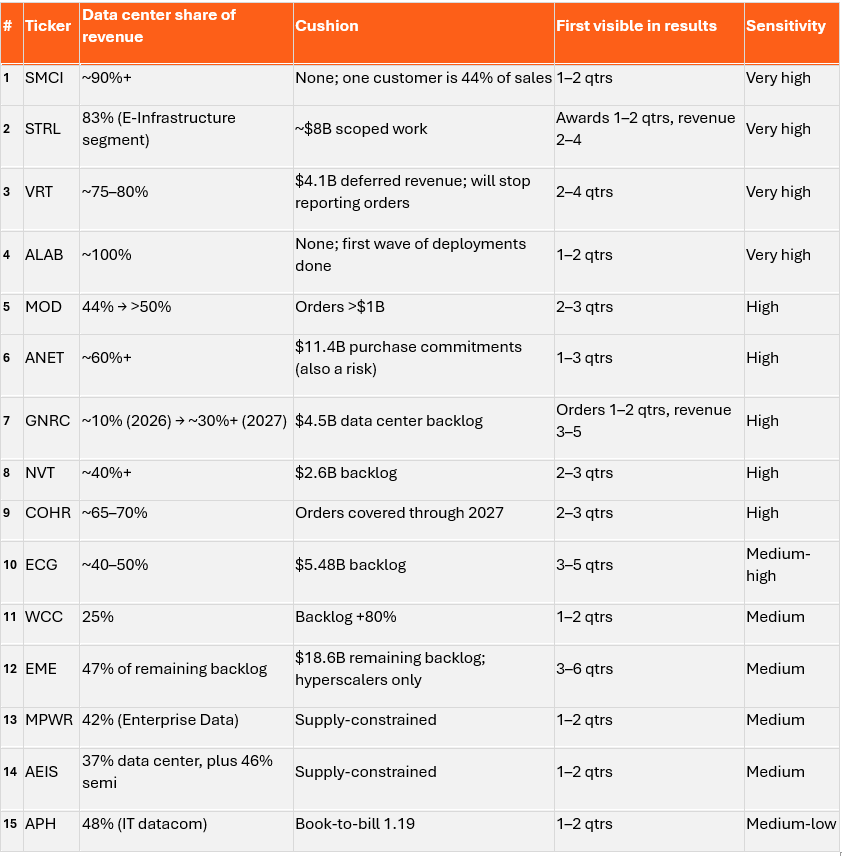
Most vulnerable now: SMCI, STRL, VRT, ALAB and MOD. Data centers drive most of their revenue, they have little backlog to cushion a slowdown, and their margins are either already under pressure or high enough that a slowdown would hit EPS hard.
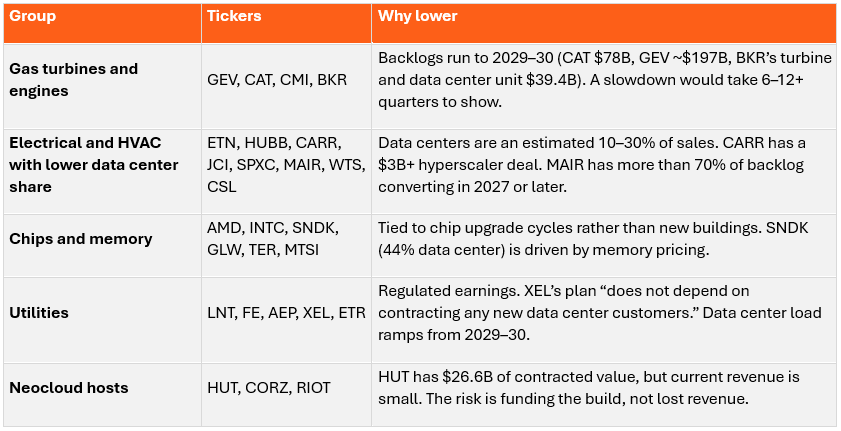
Slower to feel it: electrical and mechanical contractors (EME, ECG) and gas-turbine and engine makers (GEV, CAT). Their backlogs run 12 months or more, out to 2029–30 for turbines, so a slowdown would likely show up 3–6+ quarters later.
The election mostly works indirectly. The new Congress takes its seats in January 2027 and the President can still veto bills, so new federal laws are unlikely. The more likely routes are state moratoriums, scrutiny of who pays for grid connections to big power users, and tighter funding for neoclouds and speculative builds. The calls already show this: New York’s moratorium came up on EME’s call, and analysts asked ECG, MAIR and IRM about moratoriums and political pushback after the midterms.
Hyperscaler spending was still rising in the October results. AMZN guided about $220B, GOOG $195–205B with 2027 likely “significantly” higher, MSFT about $170B for the calendar year and META $135–145B. So a slowdown would show first as slower growth in 2027–28, and neocloud and speculative builds would be cut first.
Hedges and beneficiaries: a slowdown makes existing powered capacity scarcer, which helps owners like EQIX, DLR and IRM (IRM’s 325 MW is “fully permitted and energized”). It also eases cash burn at the hyperscalers: GOOG free cash flow was –$9.1B and META’s –$2.1B last quarter.
Exposure List (summary table at end)
This list is not exhaustive. It is drawn together solely from the results that Inferent Analyst has examined over the last 2-3 weeks (approximately 1200 results plus earnings calls in total). Other stocks, both yet to report and those with lower sensitivity can have exposure, however I tasked the model with identifying what is assesses as the top 15 exposures form the data reviewed:
1. SMCI. Super Micro sells GPU server racks and complete data center building blocks, so almost all its revenue (est.) comes from fitting out AI data centers. The quarter came in at $19.9B, almost 4x a year ago, and the FY27 guide went up to $72–82B. But one customer is now 44% of revenue (28% last year), and $2.3B of the quarter was deliveries that had slipped from earlier periods. Gross margin is only 12.7%, operating cash flow was –$434M and receivables are $9.7B. Revenue is booked when racks are deployed and there is no long backlog, so if one customer pauses new halls it shows up in the next guide, within 1–2 quarters. With margins this thin, a revenue miss falls almost entirely to EPS and working capital.
2. STRL. E-Infrastructure was 83% of Q3 revenue ($1.30B, up 212%). That is mostly site development for hyperscale data centers, plus electrical work through the CEC acquisition. Revenue rose 127% and the 2026 EPS guide is $21.70–21.96, about double last year. Site preparation is the first work done on a new campus, so fewer new starts hit Sterling before any electrical or mechanical contractor. Scoped work of about $8B is less than 1.5 years of revenue at the current pace, and E-Infrastructure margin is already lower (23.2% vs 26.8%). New awards may show a slowdown within 1–2 quarters and revenue within 2–4.
Don’t forget to pre-register for Inferent Analyst so you can be one of the first to experience the benefits of a natively agentic investment researcher that’s trained to produce deep insights for you on whats happening in markets.

3. VRT. Vertiv makes power equipment (UPS systems, switchgear, busway) and cooling equipment (cooling distribution units, chillers). About 75–80% of sales (est.) are to data centers. Q3 sales rose 61%, organic orders more than doubled, operating margin was 25.2%, and FY26 guidance is $14.65B of sales and $7.15 of EPS. Management will stop reporting orders, which removes the earliest warning sign, so a slowdown will probably show first in the 2027 guide on the Q4 call. Deferred revenue of $4.1B and roughly a year of backlog suggest revenue would roll over 2–4 quarters out. At a 25% margin and a premium valuation, each lost sale costs a lot of profit and multiple. Analysts also raised quality issues on the call (overheating compressors and UPS units).
4. ALAB. Astera Labs sells connectivity chips for AI racks (Scorpio switches and retimers), so it is almost entirely tied to AI data centers. Revenue was $585M, up 154%, and Q4 is guided to $730–750M. But gross margin is slipping (72.4%) and operating expenses are guided up to $194–200M from $162M. The CFO said the first Scorpio X platforms have “completed much of their initial deployment ramps.” Barclays pointed out that lead customers’ current builds may peak in Q1 2027, with next-generation ramps closer to 2028. That is a possible gap in demand even before any policy slowdown. There is no backlog and costs are rising, so a slowdown would show in 1–2 quarters.
5. MOD. Modine’s data center sales were $440M (up 95%), 44% of the quarter. FY27 data center growth is guided at 80–90%, orders topped $1B and it won a new hyperscaler award of more than $400M. After the Performance Technologies spin-off, data centers become most of the company. Data center margin has already fallen (15.4% vs 18.1%), and getting back to the targeted “20% or above” by fiscal Q4 depends on volume. A slowdown would cut revenue and stall the margin recovery at the same time. Free cash flow was negative in Q2. The impact would show in 2–3 quarters.
6. ANET. Arista sells Ethernet switches for AI and cloud networks, and cloud and AI customers make up most of its sales (est.). Three or four customers each exceed 10% of revenue. The 2027 guide is about $18.5B, growth of 38–40%, with AI networking alone expected to roughly double to about $7B. The risk is on the balance sheet: inventory is $3.2B, purchase commitments $11.4B, and deferred product revenue fell $86M after rising about $600M last quarter. A slowdown would show in guidance in 1–2 quarters and could bring inventory write-downs. A 49% operating margin gives much more room than SMCI has.
7. GNRC. Generac sells backup generators to data centers. Its data center backlog jumped to about $4.5B from $1.6B, including a long-term supply deal with Amazon. Data center revenue is about $500M in 2026 and expected to “well exceed $2B” in 2027, so it goes from ~10% to ~30%+ of sales (est.). The investment case now depends on that ramp. Capacity is tripling, with two-thirds of 2027 output in the second half. Generators go in late in a build, so customers can push deliveries back more easily than cancel them. The risk is delays and new factories running below capacity. Order commentary would show a slowdown in 1–2 quarters, revenue in 3–5, but the stock would likely react immediately.
8. NVT. nVent makes enclosures, liquid cooling and power distribution products. Infrastructure sales grew more than 70%, and data centers are an estimated 40%+ of revenue. Organic growth was 44% in Q3, new products added about 30 points of that, and backlog is $2.6B. Q4 organic growth is guided down to 26–29%, and the newly closed Maverick Power deal runs at mid-teens margins. New capacity in Arizona and Blaine comes online in mid-2027, which could mean new plants running below capacity in a slowdown. Liquid cooling is partly sold for retrofits of existing sites, which cushions it slightly. The impact would show in 2–3 quarters.
9. COHR. Coherent sells optical transceivers and lasers. Data center revenue rose 85% and is an estimated 65–70% of the total. FY27 pro forma growth is guided above 60%. The $20B PhotonLink agreement only starts producing revenue in 2028. Management said order coverage through calendar 2027 is “exceptional,” which buys about 2–3 quarters before a slowdown shows. Part of optical demand comes from upgrading bandwidth in existing clusters, so it is less tied to new buildings than STRL or VRT.
10. ECG (Everus). Everus is an electrical and mechanical contractor. That segment grew 48%, backlog is $5.48B (up 86%), and data centers are the largest part of it. The 2026 revenue guide is $5.0–5.1B. An analyst asked directly about election risk and moratoriums; the CEO said “We haven’t seen any change of behavior from our customers.” Everus is smaller and less diversified than EME, and Q3 included a one-off $7.6M gain. Electrical fit-out comes mid-to-late in a build, so revenue would roll over in 3–5 quarters, though new awards would show it sooner.
11. WCC. Wesco’s data center sales were $1.8B (up 55%), 25% of the total. Backlog is up more than 80% and the 2026 EPS guide is $18–18.50. As a distributor it runs on thin margins (7.8% EBITDA) and ties up about 20% of sales in working capital. Business turns over quickly and Wesco reports monthly sales per workday, so a slowdown would show within 1–2 quarters. The other 75% of sales (utility and industrial) cushions it, and management is already framing 2027 at only mid-to-high single-digit growth.
12. EME. EMCOR’s data center backlog is $8.74B, 47% of its $18.57B remaining backlog, and data centers are heading toward half of construction revenue. The 2026 EPS guide is $34.50–35.50. Management says it is “not very much into the neo-cloud market” and works for large hyperscalers, the least likely customers to cancel. It already has no data center work in New York because of the moratorium there, which shows how state policy can hit. With mid-to-late-stage work, 3+ quarters of backlog and a 10.5% margin, a slowdown would take 3–6 quarters to reach results and would cost less profit per lost sale. It is the most insulated of the contractors.
13. MPWR. Monolithic Power’s Enterprise Data segment is 42% of revenue (up 165%). Q4 is guided about 10% above consensus, and management says Enterprise Data growth will be at least 150%. These are power chips on accelerator boards, so the exposure is to accelerator shipments, including replacements, rather than to buildings. The bigger risk is capacity: it is building to $8B by H2 2027 and then $10B. Short-cycle chips mean 1–2 quarters to show a slowdown, but the other ~58% of revenue diversifies it.
14. AEIS. Advanced Energy’s data center computing revenue was $256M (37% of sales, up 49%). Semiconductor equipment was another 46%, and that is indirectly AI-driven. 2027 growth is guided at about 30%, limited by component supply. Supply shortages are currently hiding demand, so a slowdown would first show as shortages easing (1–2 quarters). The semiconductor side would follow 2–4 quarters later. Management says the 2027 outlook does not depend on a “second wave” of data center revenue.
15. APH. Amphenol’s IT datacom business is 48% of sales and grew 117% (77% organic). Book-to-bill was 1.19 and Q4 is guided up mid-single digits from Q3. Data center connector content per rack is growing, but Amphenol is highly diversified, keeps buying businesses and has a 29.7% operating margin, so it has the most room to absorb a slowdown in this list. Orders would show a slowdown in 1–2 quarters, but it would hurt earnings the least.
The Next Tier
The Summary
Andy West
The Inferential Investor & Inferent.com
Important Disclaimer: This stock discussion and analysis is subject to The Inferential Investor’s Disclaimer. This article is for informational and educational purposes only and does not constitute financial product advice or a recommendation to buy or sell any financial product or security. It has been prepared without taking into account any individual’s investment objectives, financial situation, or particular needs. Past performance is not a reliable indicator of future performance. All forward-looking statements are scenario-based assessments and not forecasts or investment recommendations. Recipients should seek independent professional financial advice before making any investment decision. AI can make mistakes and information should be independently verified.