

The following report was generated with the assistance of Inferent Analyst’s agentic intelligence workflows. Pre-register to keep informed of this unique project and get early access or subscribe to the Inferential Investor:
What are investors concerned about with GOOG?
GOOG has just reported its Q2 FY26 results and the share price is selling off. The result itself (summarized in detail here), was a small miss on EBIT and EPS but it appears that the real source of investor anxiety that is behind the share price drop, are statements from management that AI capex is set to increase again (with a further increase to the 2027 capex budget as well) at the same time free cashflow in the quarter turned negative, EBIT margins are set to dip and cheap but capable open weight models are proliferating. Investors see GOOG ramping capex further, at the same time they worry it could be losing the frontier. Here’s some key directional quotes from our transcript analysis of GOOG’s earnings call:
Q2’26 (most recent):
• “We are updating our full year 2026 CapEx guidance range to $195 billion to $205 billion... up from our previous estimate of $180 billion to $190 billion.” — Anat Ashkenazi, Q2’26
• “We plan to expand the use of third-party capacity in Q3 as a bridging strategy... it will create modest margin pressure in the near term.” — Anat Ashkenazi, Q2’26
• “We expect the free cash flow will remain under pressure, driven by our investments in technical infrastructure.” — Anat Ashkenazi, Q2’26
Consequently, this is a result that only poured fuel on the fire of questions regarding the sustainable returns that can be generated from this ever increasing AI capex. As they have been doing since the first Deepseek moment, those questions drive share prices down.
It is this last point with regard to sustainable AI returns, that this article seeks to put to bed, because the evidence is actually available to those willing to do a careful forensic analysis.
What’s the core debate?
Even as FCF this quarter turned negative, GOOG further increased capex for 2026 to over $200bn) and indicated 2027 capex would step up again. It has also zeroed the buyback and turned from a capital returner to a capital raiser. GOOG has raised over $75bn in long term debt in the last 12 months and launched an $80bn, multi-tranche equity raising this quarter, its first since its IPO in 2004. Investors see Revenue and EBIT rising, but not fast enough to offset the new capital committed and most market commentary tells you that returns on invested capital (ROIC) are falling. When ROIC falls, typically a stock’s multiple falls and share returns are poor, if not negative.
The is the headline ROIC trend on a last twelve month’s basis with no adjustments made other than normalizing out one-time equity gains from Alphabet’s investments in SpaceX and Anthropic:
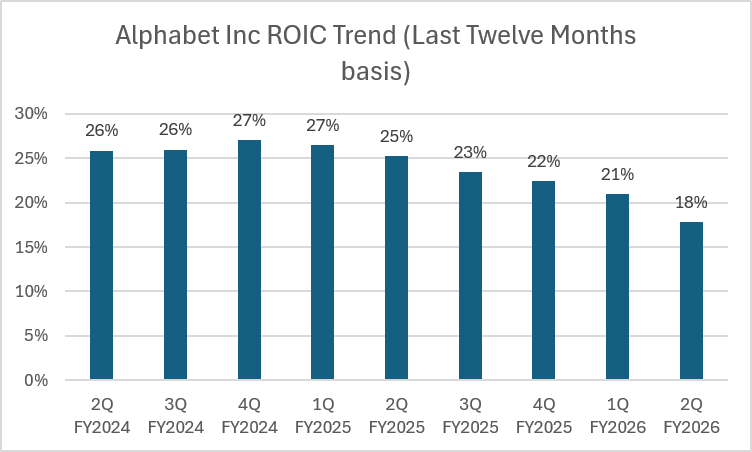
As can be seen in the chart, Alphabet’s headline ROIC has been declining since the end of 2024 as capital expenditure ramped significantly to fund the AI expansion. Quarterly capital expenditures have more than doubled from $38bn at the end of 2024 to over $80bn in Q2 2026, while quarterly adjusted EBIT has increased only by 33% from $30bn to $40bn over the same time period.
That comparison best summarizes the market’s angst. Where’s the return on all that capex?
The problem with this “point in time” view of GOOG is that it is at odds with both logic and as I’ll also show later, forensic analysis. From a pure logical assessment:
Cloud Services returns: Management have the internal information to be able to calculate projected ROIC over the length of their contracted RPOs within the Cloud division. Why would they not price to achieve a strong return? All major competitors such as AWS, Azure, Oracle, Anthropic, OpenAI and Meta indicate that demand exceeds available supply. There is no incentive to underprice.
Gemini returns: GOOG is choosing to price its Gemini model API well under frontier competitors deliberately. They have room to increase pricing if they choose with Gemini 3.1 PRO at $12 / 1M output tokens compared with $30-$50 for OpenAI and Anthropic’s top models. Gemini’s pricing is set from a ROIC framework (per CFO comments below) that benefit from a cost advantage detailed in the next point.
Vertical integration others do not have: GOOG has engineered a full stack AI cost advantage by being vertically integrated from compute (own TPUs) to data center to AI model owner. See the ground breaking analysis on this topic from 2025 here that quantifies Alphabet’s cost advantage over Anthropic and OpenAI.
Management should be assumed to be rational: When you have the power to set pricing higher on your model API but you choose not to, whilst at the same time having full transparency on the internal returns you are generating on your AI investments (something that market participants do not have), does it make sense to assume management are deliberately driving returns into the ground?
So what are management signaling to the market (even if the market is choosing to ignore it) and further, is there hard evidence to support those statements?
What are management saying?
Let’s focus on comments about this topic by Sundar Pichai (CEO) and Anat Ashkenazi (CFO) from the Q2 call. Again this is all available in our transcript analysis pack:
• GenAI ROIC opportunity & CapEx philosophy (Question by Brian Nowak, Morgan Stanley): Asked how the sizing/timing of the GenAI ROIC opportunity has changed vs. a year ago, and how CapEx budgeting philosophy is adapting to supply constraints. Pichai: called it “very early innings,” said the firm has “gotten more bullish” on opportunities over the past year. Ashkenazi: reiterated a multiyear, ROIC-driven framework; noted demand still outpaces the capacity added over the past three years.
• CapEx ROIC trajectory (Question by Ken Goralski, Wells Fargo): Asked how 2027 capacity-investment returns compare with 2025-26 given supply-chain inflation. Pichai: said return dynamics look “healthier” than a year ago given strong renewing demand signals.
Management are therefore on record signaling that (1) they are pricing on an ROIC framework, (2) that ROIC is increasing and (3) demand remains in excess of supply. Yet the market is reacting as if they are not to be believed.

Let me introduce you to Inferent Analyst - a cutting edge AI investment research platform being developed by investors - for investors. Inferent Analyst is designed to be every investor’s autonomous equity research assistant. No more pages and pages of raw numbers without context like traditional data terminals. Inferent Analyst actually interprets and analyzes the data automatically, as events unfold, presenting you with the insights you need to discover ideas and make better investment decisions. Pre-register today as subscriber seats will be limited on launch.
How do we test these statements?
The verification process is by calculating the adjusted incremental return on invested capital (“AI-ROIC”) over each of the last 5 quarters (being the period over which headline ROIC seems to be falling). What do I mean by “adjusted incremental”?
An incremental ROIC measures the return being generated on the incremental capital being added to the capital base. This is computed as the change in Net Operating Profit After Tax (NOPAT) dividend by the change in Average Invested Capital (IC). It is a more timely measure of ROIC that is useful where returns may be changing rapidly due to a shift in business mix or model. In other words it is a measure that is more sensitive to changes in the business and can signal future shifts in the headline ROIC early.
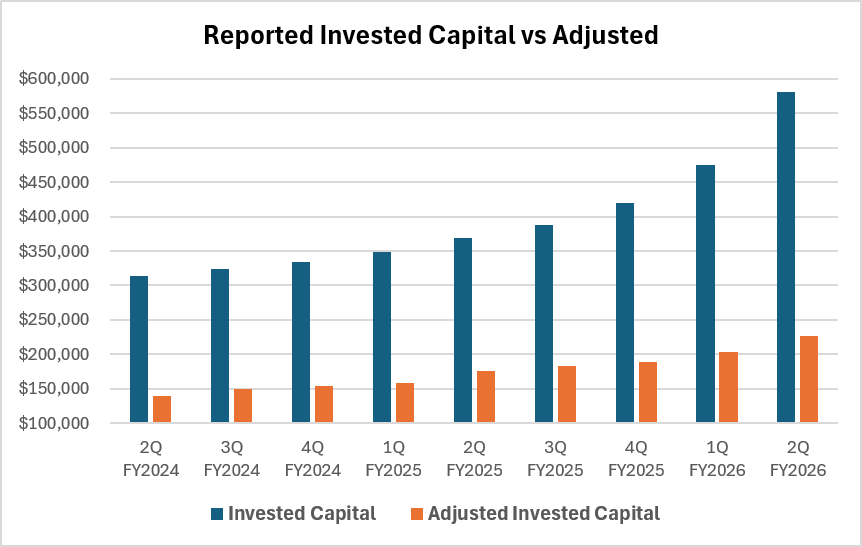
An adjusted ROIC calculation, normalizes the invested capital base for non productive capital components that are not adding to the earnings power of the company yet. In Alphabet’s case, there are two large moving components that need to be adjusted for to truly see how incremental returns are changing:
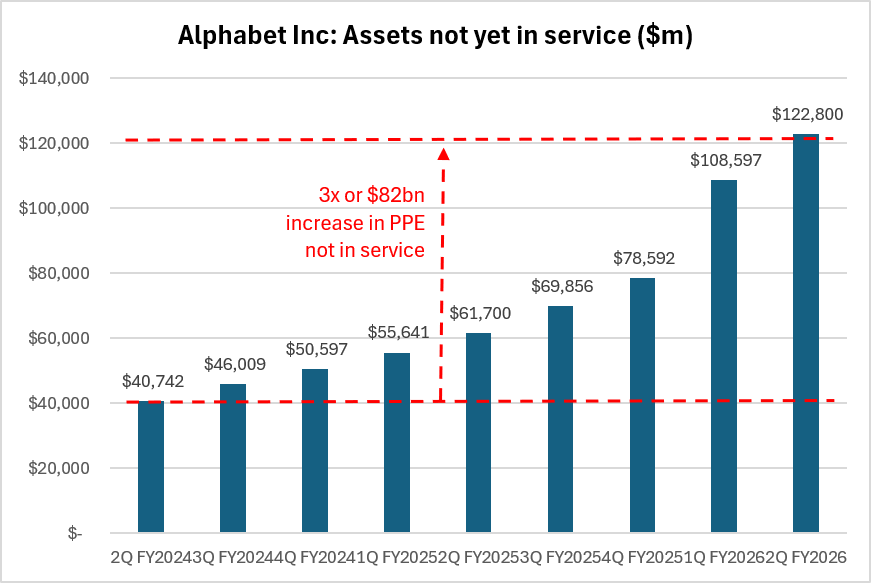
Property, plant and equipment assets not yet in service: It takes approximately 2 years to build and commission new data centers. Yet with server and compute shortages, a lot of data center equipment purchases need to be committed to up front, in order to ensure that the data center can rapidly scale when it opens. Land and shell need to be purchased and constructed over that timeframe before generating a cent of revenue. In a steady state business, it would not really matter to the ROIC calculation. However in the AI investment boom where capex is still ramping rapidly and has not yet reached steady state, it skews the calculation heavily. Luckily, these assets not yet in service are separately detailed in Alphabet’s accounts. Alphabet, as of Q2 FY26 now has $122bn of invested capital tied up in assets not yet in service. Two years ago, this was only $40bn - a 3x increase. This line item has accelerated over the last 2 quarters particularly, reflecting the recent capex ramp. That increase, being a material portion of invested capital, needs to be adjusted for to compare inter-period ROIC trends.
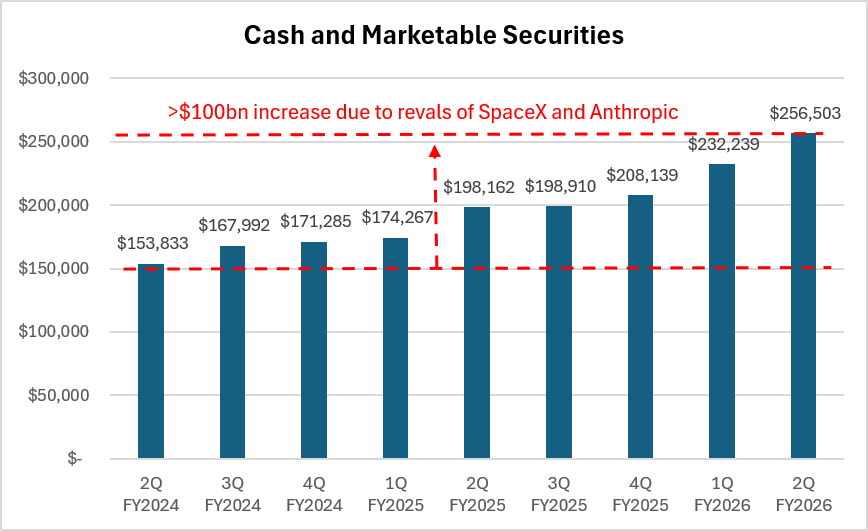
Cash and marketable securities: Once again, in a steady state business, changes in cash and marketable securities would not orinarily skew an ROIC calculation. However Alphabet has material investments in companies such as Anthropic and SpaceX where values on the balance sheet have increased materially in recent periods as investment rounds and recent IPOs have been completed. These increases in fair value on the balance sheet add to invested capital and reduce the ROIC calculation. However as these investments do not generate sustainable earnings for Alphabet and one time gains are normalized out of the NOPAT numerator of the ROIC calculation, we should also normalize them from the demoninator (IC).
Making these adjustments makes a huge different to the productive invested capital trend for Google as shown in this chart below. First - it demonstrates the large proportion of invested capital on Alphabet’s balance sheet that doesn’t natively contribute to sustainable EBIT / NOPAT. Second the ever widening gap bewteen the blue and orange columns demonstrates how the “not yet” productive portion of capital has been increasing period on period over the last 2 years as the AI investment boom ramps.
This effect is obscuring the real returns that Alphabet is achieving on its AI investments.
What does the evidence now show?
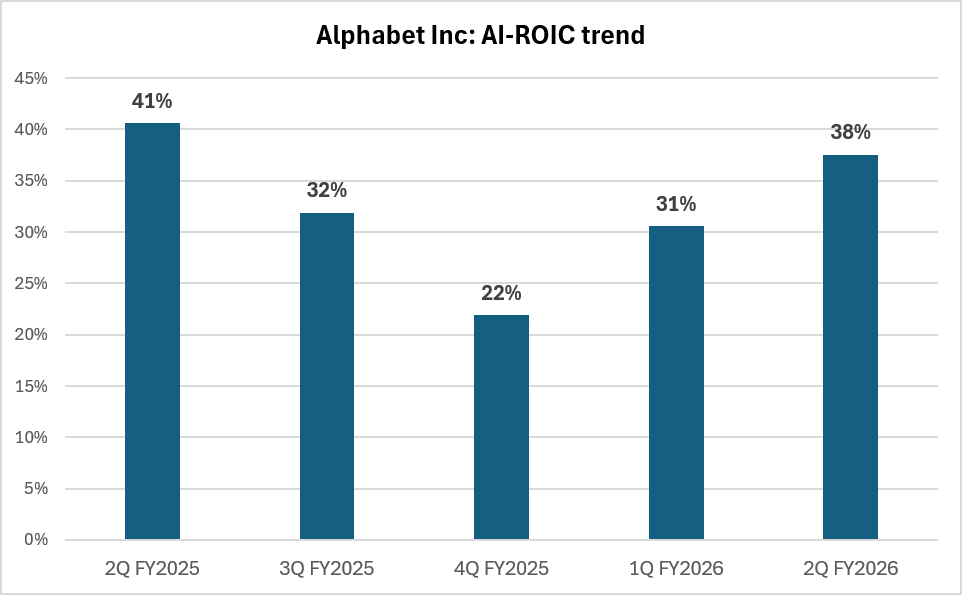
The chart below shows the underlying trend in AI-ROIC (adjusted incremental return on invested capital) once we have cleaned the data using the methodology reported above. This is what I consider the best measure of the real underlying return on invested capital that Alphabet Inc is achieving on its AI investments and the reason that Sundar Pichai is continually increasing capex even further, even as the equity market punishes him for it.
The market only sees the headline ROIC.
Management see the AI-ROIC trend.
What are the key takeaways here:
ROIC did drop in the early stages of the AI investment ramp. At its core, Alphabet, (adjusting for its “other bets” and other unproductive assets that are not yet contributing to sustainable NOPAT), is an extremely high returning business. Its core, underlying ROIC outstrips its WACC by a factor of at least 2x. This is one reason why its been such a successful long term investment able to continually reinvest in new ventures. However, core ROIC halved from 2024 to 2025 with capital committments having increased materially, but limited incrmental earnings coming through at that stage.
However underlying ROIC as measured by the incremental AI-ROIC methodology, troughed in 4Q 2025 and can be shown to have been increasing steadily since. This is not what the market believes right now. It is back towards historic levels at a very healthy 38% in Q2. This matches management’s comments regarding seeing stronger returns ahead and managing to a long term ROIC framework.
Even in 2Q 2026, as the market has punished GOOG for its small EPS miss, FCF turning negative and further capex increases, the AI-ROIC measure has increased again.
With the vast majority of Alphabet’s period on period new capital investments and incremental earnings being derived from its AI strategy, this adjusted incremental ROIC measure at 38% is giving you an inside measure of the real and very healthy return on AI for Alphabet.
So it is my view, based on these calculations that underlying returns on AI investments are very healthy, highly value accretive (compared with WACC) and that management are actually making rational investment decisions with this AI bet that will pay off over the medium term. Right now with the way the market is reacting, that appears to be a differential point of view.
The market however is unlikely to shift its view in the short term, focused as it is on headline metrics. It is, in my opinion, necessary for the market to see headline ROIC turn and capex stabilize while Gemini closes the capability gap once again (more on that below), for the stock to likely perform again.
Appexdix: Where is Google going with the Gemini model family?
Is Gemini losing the frontier? To answer that question, we need to put some parameters around it - and yes I mean that as a pun. Gemini 3.1 PRO (we haven’t seen 3.5 PRO yet as its delayed) is estimated to be built on over 1 trillion parameters. The Gemini 3.X model family however was trained with a knowledge cut-off date of Jan 2025 (18 months ago). AI model age is like cat years. It is quite frankly an OLD model now.
Compare that to Claude Fable 5. While exact numbers are not released by Anthropic, the model is estimated to be built with around 6 trillion parameters. Even Moonshot AI’s latest open weight model, Kimi K3, has 2.8 trillion parameters. This underscores how the Gemini model family needs a large update and why people are asking whether it has lost the frontier.
Parameters are one way of measuring how much information a model has been trained on. As a rule of thumb, there’s usually about 20 tokens to a parameter. And a token is about 0.7 of a word. So when you see that connection, its clear that a model like Fable 5 has been trained on 6x the volume of information, coding examples, texts, investment research articles, news reports, mathematical proofs, social media posts etc that Gemini has. And even a new, cheap open weight model like Kimi K3 has 3x as much “knowledge”.
This is why GOOG has delayed 3.5 PRO and is already investing heavily on training 4.X as an entirely new model family with a far larger parameter count. With 3.5 PRO, Sundar Pichai has been open about pushing it back to obtain more coding samples for training and help close the coding gap which is so critical for enterprise demand. With model variant 4, we can expect this gap to be closed significantly given it has been targeted and announced this quarter as a KPI.
What did Sundar Pichai say on this topic? (source: Inferent transcript analysis)
• Model release cadence has quickened, culminating in the Q2’26 launch of Gemini 3.6 Flash/3.5 Flashlight and the start of Gemini 4 pretraining, described by Pichai as “our most ambitious pretraining run yet” (Q2’26 Prepared, L13).
• Model release cadence & Flash positioning (Question by Ross Sandler, Barclays): Asked about speeding model-release cadence (citing the SpaceX third-party compute deal) and whether the low-cost Flash tier is the right place to compete given crowding. Pichai: described a “Pareto frontier” strategy spanning both frontier and low-cost models, targeting a near-monthly release cadence, with heavy compute committed to the “very ambitious” Gemini 4 effort.
What does that all mean?
It means that Google has admitted it fell behind and is allocating resources to closing the gap fast. We can expect a near monthly new model release cadence from here. Clearly more resources are being directly finally back to DeepMind that for a period were taken away to ofcus on the change to AI mode for search. Now we see the organization’s attention being refocussed back on the frontier which can only be positive in the medium term for the perception of both Gemini and GOOG.
Important Disclaimer: This analysis is subject to The Inferential Investor’s Disclaimer. It is for informational and educational purposes only and does not constitute investment advice, a recommendation to buy or sell any security, an offer or solicitation, or a guarantee of future performance. The information is derived from sources believed to be reliable but no representation or warranty is made as to its accuracy or completeness. Any forward looking or scenario descriptions are not forecasts but explorations of the implications of a set of described conditions and are subject to risk and uncertainty. Past performance is not indicative of future results. Readers should consult their own advisers before making any investment decision. This analysis is generated based on a standardized workflow. It has been prepared without taking account of your objectives, financial situation, or needs and does not constitute a recommendation on any security mentioned. You should consider the appropriateness of this information before making any investment decisions. AI can make mistakes.
Disclosure: The author holds a position in Alphabet Inc
Digging into Alphabet's real returns on AI capital is useful work, and you made the ROIC story easy to size.
Great post. Think this is the correct analysis, of adjusting IC for non-productive assets. ROIC and incremental ROIC are coming out great. Why you think market is not paying attention to this?