


The following report was generated with Inferent Analyst’s agentic intelligence workflows. Subscribe to keep informed of this unique project.
Introduction
As we test Inferent’s agentic investment research workflows, every large cap US earnings drop is being run through a multi-step process to analyze the numbers, drivers, management disclosures and earnings call as soon as the event is detected. Our systems specifically scan for changes in trends and language bewteen periods that can signal both opportunities and rising risks for investors. Out of this, our workflows then distill the key takeaways every week. Here’s a process flow of Inferent’s earnings event processes:
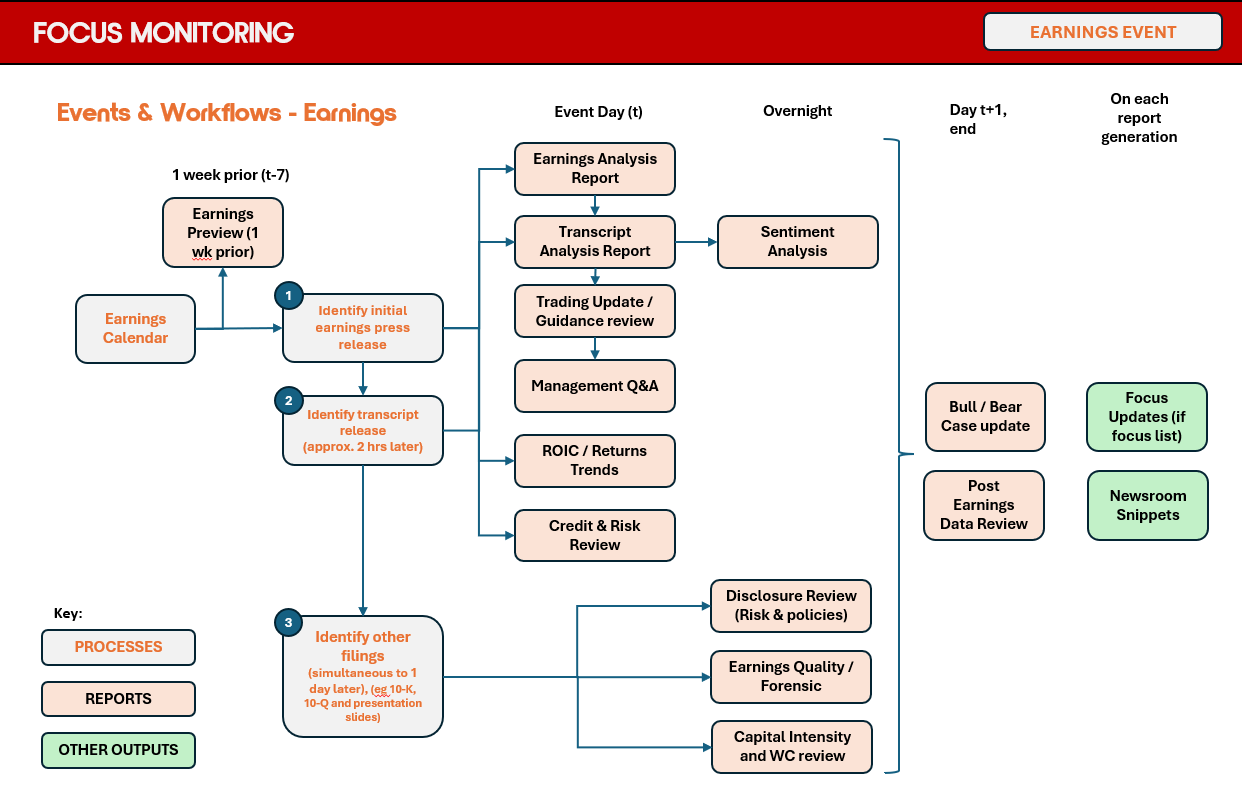
This agentic, layered monitoring and event analysis design allows investors to get across far more stocks and results, in greater depth, than they ordinarily would be able to and then focus where it matters. Below I have reproduced the key takeaways from the last week of large cap results in our “hot takes” format of 3 bullet points:
Whats changed
Growth / risk impact
Magnitude
Names below were flagged for either (a) an idiosyncratic theme material enough to move valuation/price-target inputs, and/or (b) a sentiment inflection (management and/or analyst tone) signaling a sustainable change in growth or risk profile. These are ordered alphabetically by ticker. I am keen to recieve any feedback from readers.
ABNB — Airbnb
Positive sentiment inflection; idiosyncratic hotels/AI ramp
• What changed: 2nd consecutive FY26 guidance raise (revenue to ≥mid-teens, EBITDA margin to ≥35.5%); hotels business now growing ~3x platform rate; Reserve Now Pay Later >20% of GBV; Middle East cancellation headwind (flagged Q1) largely receded (”less than we had anticipated”).
• Growth/risk impact: Accelerating growth trend (+12%→+18%→+17% YoY over 3 quarters) with reduced macro overhang supports modest upward revision to near-term estimates; embedded FY guide floor still implies deceleration to ~10-11% YoY by Q4 — magnitude of deceleration not fully explained by management beyond “tougher comps.”
• Magnitude: Sentiment score +3.0 (MD&A basis), largest positive delta with a real fundamental driver (not just tone). Take-rate outlook softened slightly (flat vs. prior “slightly higher”), a modest offset.
AIG — American International Group
Negative sentiment inflection; idiosyncratic pricing-cycle shift
• What changed: Management explicitly flagged a pricing-cycle regime shift from “broad positive pricing” to a “more selective” environment; every growth metric decelerated sharply QoQ (NPW +9% vs +24%; AATI EPS +10.5% vs +80.3%); International Commercial combined ratio worsened 540bps on conflict-related catastrophe losses (~$75M).
• Growth/risk impact: Underwriting growth/margin trajectory likely inflects toward high-single-digit rather than prior-quarter’s exceptional pace; reliance on favorable reserve development ($145M) to support results is a quality flag if it doesn’t repeat.
• Magnitude: MD&A sentiment score -4.0, the largest deterioration in the cohort; partly a comp effect (Q1’25 catastrophe-light base) but the pricing-cycle commentary is a genuine, management-acknowledged inflection with unquantified duration.
APP — AppLovin
Sharpest negative sentiment inflection in the batch; idiosyncratic model-cadence miss
• What changed: First quarter of three reviewed to miss its own guidance; management explicitly acknowledged “we fell short of that standard” on gaming-model improvement cadence; Q3 margin guide cut to ~83% from 84-85% actual.
• Growth/risk impact: Revenue growth decelerating three straight quarters (59%→53%→~47% guided) — a genuine deceleration, not merely tough comps, since management itself cites an execution/model-cadence shortfall as the proximate cause.
• Magnitude: Prepared-remarks sentiment fell 18→11 (transcript basis), the sharpest single-quarter drop across all 33 names reviewed. Partial offset: SEC inquiry closed with no action; compute-cost/margin framework (~$0.10/incremental revenue $) remains quantified and bounded, limiting downside to the margin case.
BKNG — Booking Holdings
Negative growth inflection; idiosyncratic Middle East drag extension
• What changed: FY26 gross bookings/revenue guide trimmed to “high single digits” from “high-single-to-low-double-digits”; Middle East disruption assumption extended from 3 to 7 of 12 months; flight-ticket unit growth collapsed to +4% YoY from +28% (Q1)/+37% (FY25); SEO/organic-traffic pressure disclosed for the first time.
• Growth/risk impact: Most consistent multi-quarter deceleration in the cohort — room nights +9%→+6%→+5%, bookings +16%→+15%→+9% over three quarters — with Q3 guide sitting below where sell-side consensus is currently positioned, a setup for further estimate cuts.
• Magnitude: MD&A sentiment -2.5 (14.0→11.5); Street/guidance gap (~4-6pp) is itself a material near-term estimate-revision risk independent of the underlying travel-demand debate.
CAT — Caterpillar
Largest positive sentiment inflection; idiosyncratic AI-power supercycle
• What changed: First-ever quarter above $20B revenue; Power Gen sales-to-users +72% YoY; large reciprocating engine capacity target raised to ~3x 2024 levels with lead times to 2028/2029; FY26 revenue-growth guide moved from low-double-digit to mid-to-high-teens.
• Growth/risk impact: Real, structural growth acceleration (revenue +18%→+22%→+24% YoY; EPS +30%→+73% YoY over three quarters) tied to durable data-center power demand — supports upward revision to medium-term power-gen revenue/margin assumptions, though backlog duration is lengthening (share shippable within 12 months down to 59% from 62%) and $392M of the quarter’s margin was a non-recurring IEEPA tariff recovery.
• Magnitude: MD&A sentiment +3.0, the largest positive delta in the batch; analysts (BofA’s Feniger) are now explicitly raising AI/data-center capacity overbuild risk as the offsetting consideration.
Analysis continues after this quick intro to Inferent Analyst:

Let me introduce you to Inferent Analyst - a cutting edge AI investment research platform being developed by investors - for investors. Inferent Analyst is designed to be every investor’s autonomous equity research assistant. No more pages and pages of raw numbers without context like traditional data terminals. Inferent Analyst actually interprets and analyzes the data automatically, as events unfold, presenting you with the insights you need to discover ideas and make better investment decisions. Pre-register today as subscriber seats will be limited on launch.
CEG — Constellation Energy
Idiosyncratic capital-structure transformation via Calpine
• What changed: Post-Calpine close, net debt roughly tripled to ~$24.7B; H1 FCF swung negative (~-$968M) as capex rose 60%; signed 920MW of long-term nuclear PPAs including a first-ever Walmart deal; FERC/PJM co-location rule timeline moved up to 1H 2027.
• Growth/risk impact: Second consecutive FY26 EPS guidance raise (midpoint +4.3%) demonstrates the expanded platform’s earnings power, but the leverage step-up materially changes the risk/return and equity-value-per-share bridge versus the pre-Calpine model; no credit-rating commentary was provided.
• Magnitude: Sentiment +2-3pts, but the leverage/FCF shift is the more valuation-relevant data point — a capital-structure re-rating input independent of the earnings beat.
CVS — CVS Health
Bifurcated inflection: improving 2026 results vs. new unquantified 2027 headwinds
• What changed: Third consecutive FY26 guidance raise (Adj. EPS to $7.90-8.10, +13% cumulative in six months); simultaneously disclosed first-ever 340B pressure since 2024 and a new forward warning on 2027 Caremark (PBM) membership decline — both unquantified.
• Growth/risk impact: 2026 upside is partly non-recurring (favorable prior-year reserve development, absence of a prior premium-deficiency reserve contributed ~140bps of the MBR improvement) while the new 2027 headwinds could offset a meaningful share of the momentum once sized — a genuine divergence between near-term print quality and forward risk profile.
• Magnitude: Sentiment +1.5-3.5pts even as “headwind” mentions jumped from 1 to 14 quarter-over-quarter — management itself is layering caution onto good results, a signal worth pricing into 2027 estimates ahead of specifics.
DASH — DoorDash
Idiosyncratic profitability-quality divergence beneath a headline beat
• What changed: EBITDA beat (+6.7%) but GAAP operating income (-19.9%), net income (-7.8%) and EPS (-1.7%) all missed; formal FY26 guidance was withdrawn (present at Q1); legal/tax/regulatory expense more than doubled YoY to $98M; new $700-800M FY26 FCF headwind disclosed from payment timing.
• Growth/risk impact: Ex-Deliveroo organic growth (orders +17% vs. +27% consolidated) is materially slower than the headline suggests — inorganic (M&A) contribution is now a meaningful share of reported growth, a distinction that should flow into any DCF/multiple applied to “growth.”
• Magnitude: Sentiment -1.5pts; cost-discipline framework (2% of GOV target) has been breached in each of the last three quarters (2.0%→2.7%→3.2%) — a persistent, worsening trend rather than a one-quarter miss.
DDOG — Datadog
Negative inflection: customer-concentration risk materialized
• What changed: Largest single customer disclosed a usage reduction beginning Q3’26 despite a contract renewal; management “fully de-risked” guidance for it but declined to quantify magnitude — converting a previously qualitative risk (raised by analysts since Q4’25) into a concrete, guided financial event.
• Growth/risk impact: Ex-largest-customer growth is accelerating (5 consecutive quarters), which should partially offset the headline risk, but disclosure remains too thin to size the P&L impact confidently — a genuine unresolved model input. Gross margin has compressed for 3 straight quarters (81.4%→79.6%) and FCF margin for 3 straight quarters (31%→25%), both unaddressed by management.
• Magnitude: Prepared-remarks sentiment fell to 14/20 from 18/20 (Q1’26) — first sequential dip in the series; Q&A tone fell to the most negative of three quarters (10/20 vs 14/20 Q1).
DIS — Walt Disney
Positive sentiment inflection; idiosyncratic Experiences strength vs. Sports miss
• What changed: Total segment operating income growth accelerated from +4% (Q2) to +21% (Q3); Experiences delivered a record $10B quarter (+10% YoY) on two new cruise ships; buyback target raised to ≥$9.0B (2nd raise this year); but Sports operating income fell 17% YoY, a second straight quarter below guided profitability.
• Growth/risk impact: Experiences strength (record per-cap spend +4% YoY, refuting discount-cannibalization concerns) supports the segment’s medium-term growth case; persistent Sports underperformance (carriage disputes, shorter NBA postseason) is a smaller but recurring drag worth isolating in segment models.
• Magnitude: Sentiment +1.5-3pts; A+E Global Media divestiture ($1.2B, $812M impairment) and a new, undefined labor/SG&A cost-reduction program add modest near-term execution/regulatory-approval risk.
EMR — Emerson Electric
Large positive sentiment inflection, but guidance now essentially priced in
• What changed: MD&A sentiment +4.7, one of the largest tone swings in the batch, as underlying sales growth reaccelerated to 6% from 0.5% (Q2) on a lapped software-renewal headwind; but FY26 adj. EPS guidance (~$6.55) moved to merely in-line with consensus rather than above it, and free cash flow (+36% YoY) was flattered by a non-recurring $82M tariff refund.
• Growth/risk impact: Much of the reacceleration is mechanical rollover rather than fresh demand; backlog/book-to-bill has decelerated for three straight periods (1.13→1.07→1.0) even as current-quarter sales accelerate — an order-visibility flag that could cap the durability of the improved tone.
• Magnitude: Middle East cost-disclosure granularity was reduced even as the dollar estimate improved ($150M→$100M) — a visibility trade-off; an unexplained EBITA→EBITDA metric relabeling across quarters warrants 10-Q verification.
FANG — Diamondback Energy
Positive inflection tied to a reversible macro catalyst; idiosyncratic capital-allocation regime change
• What changed: Record 1.0mm BOE/d production (first time in company history); board doubled buyback authorization to $16.0B and removed the prior formulaic minimum-return framework for discretionary allocation; Barnett/Woodford shale drilling costs falling toward competitiveness with core Midland returns.
• Growth/risk impact: FY oil-production guide raised (+2.9%) with capex held flat, implying improving capital efficiency; but Q3 oil guidance is essentially flat vs. Q2 actual, signaling a production plateau embedded within the raise — a subtle deceleration inside an otherwise bullish narrative. Growth catalyst (oil-supply shock) is explicitly reversible per management (”could be resolved today”).
• Magnitude: Sentiment +4.5, one of the largest positive deltas in the batch; new optionality (Bryant Ranch data-center power project, EOR pilot scaling) not yet reflected in NAV/guidance.
LLY — Eli Lilly
Idiosyncratic regulatory risk newly disclosed amid still-strong growth
• What changed: Retatrutide (next-gen obesity asset) BLA-vs-NDA pathway dispute disclosed, described as “active litigation” with the FDA; US submission timeline pushed to Q1 2027 from an earlier expectation — a fresh, material pipeline-timeline risk not present in the prior two quarters.
• Growth/risk impact: Core franchise remains exceptional (revenue +48% YoY, guidance raised for a third consecutive quarter), but the retatrutide delay pushes out a key next-gen growth driver by at least a year, and pricing power is showing early cracks (global realized pricing -13% YoY on China reimbursement-list inclusion; US Zepbound net price expected to compress toward Novo’s Wegovy).
• Magnitude: Sentiment cooled modestly (18.0→16.5 MD&A basis); analyst Q&A tone cooled from 13/20 to 11/20 on Foundayo launch-curve and pricing-sustainability questions — modest but genuine inflection beneath a still-bullish headline.
MCD — McDonald’s
Clear negative sentiment inflection; idiosyncratic self-inflicted execution failure
• What changed: US comp decelerated from +6.8% to +0.8% (July turned slightly negative); management explicitly attributed the bulk of the miss to inconsistent EDAP value-program rollout (~60-65% franchisee compliance) and an overloaded Q2 promo calendar — a rare direct admission of execution failure (”not acceptable,” “we simply didn’t execute”). 50,000-restaurant target slipped a full year to 2028.
• Growth/risk impact: This is a fixable, company-specific execution issue rather than a demand-destruction event, but the magnitude (comp deceleration of ~5-6pts) and the credibility hit to long-term unit targets both plausibly shift near-term comp and margin assumptions lower until the September 23 Investor Day provides a reset plan.
• Magnitude: Prepared-remarks sentiment fell from 16/20 (Q4’25) to 8/20 (Q2’26), the largest negative swing in the batch; concurrent unplanned US President change (Erlinger→Anderson) adds execution-continuity risk.
MELI — MercadoLibre
Divergence: growth accelerating, margin/credit-quality signals inflecting more cautious
• What changed: Revenue growth is the fastest in ~4 years (45%→49%→50% YoY over three quarters), but operating margin compressed 550bps YoY to 6.7%, credit-card NIMAL turned negative (-2.5% vs. breakeven a year ago), and analysts flagged a new “quite meaningful deterioration” in the over-90-day NPL bucket.
• Growth/risk impact: This is a case (iii)-type divergence — growth strengthening while margin/credit signals inflect negatively — that could pressure fintech-segment valuation multiples even as e-commerce GMV outperforms; Mexico faces new chip-cost/tax-reform headwinds and Argentina growth decelerated sharply (65%→38% YoY FX-neutral GMV).
• Magnitude: Sentiment -1.0pt (still elevated in absolute terms); net debt/EBITDA (incl. fintech debt) rose to 1.65x from 1.05x a year ago — a leverage trend worth tracking alongside the credit-quality flag.
META - META Platforms
Growth deceleration as investment intensity hits new highs and debt climbs.
• What changed: Q2’26 missed on revenue (-0.9%) and EPS (-15.6%), driven by a $2.40B legal charge (matter undisclosed) and $1.18B severance (May RIF, ~8,000 roles); GAAP op margin compressed to 31% from 41% in each of the prior two quarters; FCF collapsed to $784M (from $12.4B in Q1); capex raised (low end to $130B from $125B) and funded increasingly by debt (+$25B QoQ to $83.7B); tax-rate guide raised to 15–17% from 13–16%; Q3 revenue guide ($62.5B midpoint) sits ~3% below consensus.
• Growth/risk impact: Revenue growth is decelerating on a clean trend (+33%→+28%→~22% guided QoQ) and DAP growth also slowed (4%→3%). The more durable risk-profile shift is capital-structure related: FCF is now materially capex-constrained, debt is rising as a deliberate financing choice per the CFO and with heavy investment ahead will likely become a rising risk focus by the market, 2027 capex visibility remains withheld for a third straight quarter, and the legal reserve’s opacity leaves regulatory/litigation risk unquantified.
• Magnitude: MD&A sentiment score fell 16→13 (delta -3.0); call-level sentiment also declined across prepared remarks (14→12) and Q&A (12→11 analyst, 13→11 management), the third consecutive quarterly step-down (15→14→12 prepared). Analyst questioning shifted visibly toward capital-structure/financing and monetization proof-points rather than growth. Net: a real (not just cosmetic) tone deterioration — near-term estimate revisions likely modest/downward (EPS, FCF), with the capex/leverage trajectory the more relevant multi-quarter watch item for valuation inputs (WACC/leverage, FCF-based valuation methods).
PFE — Pfizer
Idiosyncratic leadership transition and oncology miss beneath a topline raise
• What changed: FY26 revenue guidance raised, but CFO Dave Denton is departing (interim replacement named); a Phase III oncology asset (sigvotatug vedotin) missed its primary OS endpoint, contributing to a $4.3B non-cash impairment; remaining BD capacity shrank from ~$7B to ~$6B post-Innovent close.
• Growth/risk impact: Both revenue and EPS guidance sit below Street consensus despite the raise (rev -1.4%, EPS -3.0%), a setup for possible consensus compression even after a beat quarter; COVID portfolio guidance was cut further (~$5B to ~$4B).
• Magnitude: Sentiment mixed (+2.2 MD&A / -3pts transcript basis depending on methodology) reflecting the tension between a genuine topline improvement and fresh leadership/pipeline setbacks — analyst Q&A grew more adversarial on dividend sustainability and 340B exposure.
PLTR — Palantir
Idiosyncratic customer-concentration and margin-mix risk amid record growth
• What changed: Record revenue (+92.8% YoY) and largest-ever single-quarter guidance raise, but adjusted gross margin compressed 200bps (88%→86%) as Palantir began absorbing cloud-hosting costs for a government customer; top-20 customer TTM revenue concentration rose +67% YoY for a fourth straight quarter of acceleration, with no aggregate concentration % disclosed.
• Growth/risk impact: FY guidance growth rate (82%) sits below both Q1 (85%) and Q2 (93%) actual YoY growth — management’s own numbers imply H2 deceleration even amid record results; the margin compression, if it recurs on future government deals, could structurally lower blended gross margin versus current model assumptions.
• Magnitude: Q&A sentiment stayed flat/slightly down even as prepared-remarks tone hit new highs — a widening gap between management euphoria and analyst tone worth monitoring for a re-rating catalyst.
UBER — Uber Technologies
Negative sentiment inflection; idiosyncratic bookings/revenue divergence
• What changed: Gross Bookings +24% YoY but revenue only +12% YoY — an 8-point gap management attributes to unspecified “business model changes,” concentrated in Mobility (revenue +1% vs. bookings +22%); buybacks cut 83% QoQ ($3.03B→$518M) alongside $4.0B of new debt and an unexplained $1.64B total-return-swap purchase.
• Growth/risk impact: The bookings/revenue divergence is a genuine model-revision risk if it persists — analysts should confirm whether it is a durable business-mix effect or a disclosure/accounting artifact; the Delivery Hero acquisition (~$4B, integration through 2029) and a new $10B multiyear AV commitment both represent large, multi-year, thinly detailed capital commitments.
• Magnitude: MD&A sentiment -1.5pts; Q&A tone the most skeptical of three quarters (10/20 vs 12/20); “concern” mentions jumped from 0-1 to 5 and “softness” appeared for the first time.
WDC — Western Digital
Early negative signals beneath a strong beat-and-raise
• What changed: Exabyte (unit) growth decelerated to +22% YoY from +34% (Q3), now below management’s own “>25% CAGR” long-term framework; growth increasingly price-led rather than volume-led (blended price/TB moved from flat to high-teens YoY growth over two quarters); first-ever unfavorable direct competitor gross-margin comparison raised in Q&A (Cantor’s Muse), with management unable to provide a specific bps bridge.
• Growth/risk impact: If unit growth continues to decelerate below the long-term framework while price/mix does the heavy lifting, the durability of the AI-storage growth narrative embedded in current multiples is more fragile than the headline print (revenue +43.8% YoY, EPS +109.4% YoY) suggests.
• Magnitude: Q&A sentiment fell sharply to 10/20 from 14/20 (Q3) — the first materially critical call in the three-quarter window, even as MD&A sentiment rose (+2.0) on the beat itself — a divergence between backward-looking results and forward-looking analyst concern.
VRTX — Vertex Pharmaceuticals
Divergence: revenue growth accelerating, EPS/margin conversion deteriorating
• What changed: $8.8B Crinetics acquisition (funded via cash + new $4.5B term loan) adds a fifth disease pillar but is only accretive to non-GAAP operating income from 2029; gross margin stepped down to 85.6% as higher-COGS CASGEVY mix grows, flagged to worsen further in H2; JOURNAVX gross-to-net normalization pushed back again (now 1H27, from 2H26 previously).
• Growth/risk impact: Revenue growth is accelerating (8%→12% YoY) but EPS growth decelerated sharply (26%→10%→5% YoY over three quarters) as SG&A investment (+45% YoY) compresses leverage even as the topline improves — a case (iii) divergence between reported growth quality and reported growth quantity that should temper multiple expansion even with the guidance raise.
• Magnitude: Sentiment +1.5-2.0pts (management increasingly confident); povetacicept BLA (PDUFA Nov 30, 2026) is a binary near-term catalyst not yet in the base case.
Important Disclaimer: This analysis is subject to The Inferential Investor’s Disclaimer. It is for informational and educational purposes only and does not constitute investment advice, a recommendation to buy or sell any security, an offer or solicitation, or a guarantee of future performance. The information is derived from sources believed to be reliable but no representation or warranty is made as to its accuracy or completeness. Any forward looking or scenario descriptions are not forecasts but explorations of the implications of a set of described conditions and are subject to risk and uncertainty. Past performance is not indicative of future results. Readers should consult their own advisers before making any investment decision. This analysis is generated based on a standardized workflow. It has been prepared without taking account of your objectives, financial situation, or needs and does not constitute a recommendation on any security mentioned. You should consider the appropriateness of this information before making any investment decisions. AI can make mistakes.