There’s been lots of hype about Meta’s Muse AI Agent launch:
10m downloads making it the most successful app launch since ChatGPT; stories about people having it negotiate discounts and refunds on their behalf; projections that personal AI agents will change the way we do everything.
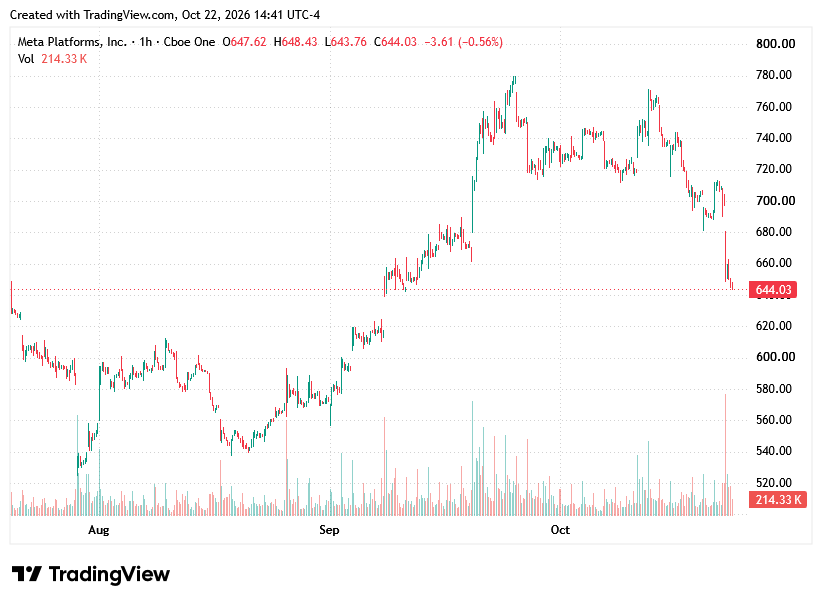
This narrative got investors excited. The share price rocketed over 30% as the news hype intensified.
The number of “I told you so” substack posts from investor blogs, including some very big names was deafening. The trouble however was that when you read every single one of these, it was all more narrative telling, dangling of large and unsupported TAM numbers and no real analysis.
The common underpinning and the only real detail these “investment theses” hinged on at the end of the day, was that Meta was in “AI” and was on 16x forward earnings - that’s goto be the opportunity of a lifetime, hasn’t it? All of them consist of lots of words and qualitative claims with little, if any, real analysis.
Some reality is setting in now. Meta’s share price is back down to a level that’s not much more that where it was pre-launch. Nearly 80% of Muse Agent downloaders have dropped the app after 14 days. Severe privacy overstep stories are emerging. Q3 earnings dropped and while its the usual “beat” against managed numbers, its another sequential revenue slowdown with Q4 projected to slow further. As I’ve written about here - the real shock ahead is likely however Q1 FY27. The blogs are much quieter on Meta today.
The reality for Meta is that despite $274bn of AI capex since 2023 and another $200bn projected in 2027, its revenue growth rate is tracking at no more than the average of the 5 or 6 years pre-AI.
Even its Ad focused AI “successes” are somewhat questionable: Its Ad price growth is tracking sideways versus an expectation of material acceleration from AI targeting benefits and its 2-year stack revenue growth rate is static - showing that period to period revenue acceleration or deceleration is simply noise from cycling prior year comps with the real underlying growth rate basically unchanged.
Meta’s AI strategy is quite simply not changing its opportunity set materially and there’s very good reasons for that as I show below - its the strategy itself.
So here’s the hard evidence why Meta’s Muse Agent is irrelevant noise…
Meta has 2 methods of monetizing the Muse Agent: subscriptions and commerce. The trouble is - given the size of Meta, both are immaterial.
Subscriptions:
Lets assume that over the next 3 years, 1 BILLION people try the Meta Muse Agent app (that number tracks the ChatGPT app experience). Over time, 90% churn out given the current degradation curve, leaving 100m users of varying intensity. That’s a massive opportunity I hear the bloggers say. ONE HUNDRED MILLION is a big number. Meta’s goto be a buy.
However with significant free use designed into the app, assume 8% of users chose a paid subscription (ChatGPT is between 5% and 12% depending on weekly or monthly definitions).
So 8 million people pay $240 a year = ~$2bn revenue opportunity.
Meta is a $250bn revenue a year company. That’s not even a 1% lift. Factor in the compute costs, depreciation, data centers, server costs, R&D expenses and not to mention share based comp to attract the AI engineering talent and based on subscriptions alone, Meta’s AI agent is another value destroying Reality Labs experiment - only potentially much more value destroying in absolute magnitude.
Agentic commerce:
The bulls acknowledge this subscription limitation, I believe. Subscriptions are irrelevant and will never move the needle nor cover Meta’s AI costs , let alone earn a return on invested capital.
Instead they point to the e-commerce opportunity. Meta has 4bn MAU across its family of apps. Convert these users via a free interface and then get them spending with the Muse app as their “buyer’s agent”. Travel, insurance, mortgage refinancing, clothes, hand bags, shoes etc. If Meta can get them using an agent to complete the deal, they can potentially earn a take rate from the merchant. That’s goto double the company, right?
We’ve heard this argument before. Meta launched Facebook Shops with a 5% take rate back in 2020 and after various problems with the strategy, made a complete exit by 2025. OpenAI tried to do a similar thing with “Instant Checkout” and its Agentic Commerce Protocol before exiting that after realizing that other than a few early adopters, most people liked using AI for research on purchases, but few actually wanted to transact via a chat interface (or allow an agent to do it for them with access to payment cards, bank accounts and potentially unauthorized activity). Large e-commerce platforms like Amazon also shut the door on them (just as its already done to personal agents), freezing out a large portion of the market.
This time, Meta doesn’t want to take the same execution risks on things like refunds and charge backs, inventory availability, stale shop-fronts etc and instead is trying to align themselves with both payment providers and large e-commerce retailers. That all sounds very tech-y and strategic and smart, based on lessons learned from the past. However it also has its own execution risks as shown by Amazon’s prohibition and Walmart’s 3x worse conversion stats from its AI related agentic commerce experiment.
More importantly, it also misses the main point that this strategy is largely irrelevant on a big picture basis versus the existing Ad business. I suggest that the cost and complexity of the Muse personal agent will result in another messy exit (and potential huge write-downs) in a few years because once again, the revenue opportunity is not what it seems, regulatory scrutiny will mount and revenue will not follow.
Meta’s Take-Rate Disconnect
Everyone knows that Meta is in the ad business. In fact its projected to overtake Alphabet in Ad revenues this year. What’s not really understood is that Meta is actually in the E-commerce business - its just that Ads are its Trojan horse to extracting a high take rate without most people realizing.
Meta already averages about a 25% Take Rate on around a trillion dollars of e-commerce transactions a year!
What!?! A 25% take rate?
That’s right - run the numbers as I show below and you can see that when you look at Meta from the perspective of the transactions it’s advertising business enables, its actually already taking around 25% of every transaction that occurs, simply through Ads.
Here’s the proof:

The calculation above takes an ad budget of a notional $100.
assumes an average $12.50 cost per thousand ad impressions (CPM) across the platforms based on research;
an average 2% conversion from impressions to click;
an average 2.5% conversion of click to purchase (equaling Impression to Sale conversion of an average 0.05%);
an average sale of $100 (range based on research typically $85-$120)
Using these inputs you can see that $100 of advertising on Meta’s platform is typically expected to generate about $400 of sales for an average merchant - the range can vary widely but its a good rule of thumb for consumer businesses. That means that Meta’s effective take rate via its Ad business averages around 25% of every revenue dollar generated. That statistic likely surprises most people. I’ve provided low to high ranges in the table as well based on a variety of assumptions.
Why is it relevant? Because both research and reporting suggest that Meta may target a 2% to 5% take rate on average across its Agentic commerce strategy. That’s a take rate that is 80-90% smaller than its current effective take rate!
Given competition in the personal agent space (OpenAI’s Dots, Claude’s Duet, Gemini’s Spark, Instinct, Grok bot and the next hundred competitors that will be launched), the actual Serviceable Obtainable Market for this is only a portion of the transactions that originate across its family of apps ad platform.
So Meta’s entire strategy of spending up to a cumulative $600bn billion in capex (that’s 4x the entire invested capital base pre Generate AI, that itself supported the $250bn a year Ad business with an effective 25% take-rate) brings it an incremental opportunity that is 80-90% smaller than the effective economics of its Ad business on a smaller base on transactions.
Put it another way - the economics of the existing Ad business cant be replicated. AI, focused on consumer applications, will fail to generate a return.
The Crux of the Issue - Meta is fixated on its user base
This is a strategic misstep that dwarfs Reality Labs and the Metaverse in size and impact. The problem comes from the usual source - a business’ legacy asset. In Meta’s case, that is its consumer user base and the Ad business that rides on this. Meta sits there thinking - “I own the eyeballs of 4bn users” and cannot think outside that framework. For them, every technology and opportunity is therefore a consumer opportunity. We see this constantly with large dominant businesses. We saw it with the Metaverse disaster and we’re seeing it again with the fixation on AI glasses that solve no discernible problem but have been the company’s dominant hardware focus after the complete failure of Quest headsets.
What they should be asking is, where does AI make the most sense? Where does it provide the greatest benefit as that will be where the monetization is greatest? They didn’t ask that question when they lurched into virtual reality or pervert glasses, and they still aren’t asking it.
Anthropic is the only company that seemed to understand this from the outset. SpaceXAITelsaGrok’s latest result has shown that they cottoned on to it as well, OpenAI got it wrong from the outset but has now pivoted to correct the mistake and even Alphabet has just shown that it has refocused its activities towards this area: its enterprises, not consumers.
The core advantage AI brings is that it can do knowledge work faster and more accurately than humans. That means that the core of its value proposition is its role in productivity. Productivity is valued where labor cost is high. Hence AI spend and value will be greatest in the enterprise space - not the consumer space, where most people cant put a value on their own time.
AS I’ve said, Meta did this with its Metaverse - see a cool technology and see how they can try and tailor it to a consumer use. That didn’t work out (understatement). I see this heading much the same way with their current AI strategy. Meta’s consumer focused efforts will never generate the returns they require - as the calculations above show. They will at some point, as SpaceX has done, pivot to renting significant amounts of compute to the AI companies serving enterprises, because that’s where the real demand and value lies.
For now and for Meta, however, the hyper related to personal AI agents is just that - hype that the calculations show are unlikely to ever be relevant.
Don’t forget to pre-register for Inferent Analyst so you can be one of the first to experience the benefits of a natively agentic investment researcher that’s trained to produce deep insights for you on whats happening in markets.

Andy West
The Inferential Investor
Disclosure: Though it may sound like I’m short Meta - I have no position whatsoever.