

By reading this article, readers acknowledge the terms of our full legal disclaimer. The information provided herein is for educational and general informational purposes only and does not constitute professional financial or investment advice. Any linked articles that refer to individual securities do not constitute or infer any investment recommendation or financial advice. They are indicative samples as to the techniques being profiled, may be out of date and are AI generated. AI models can make mistakes. Users should verify all information and conclusions with licensed financial professionals.
How AI is Mastering Deep Sector Analysis
By The Inferential Investor
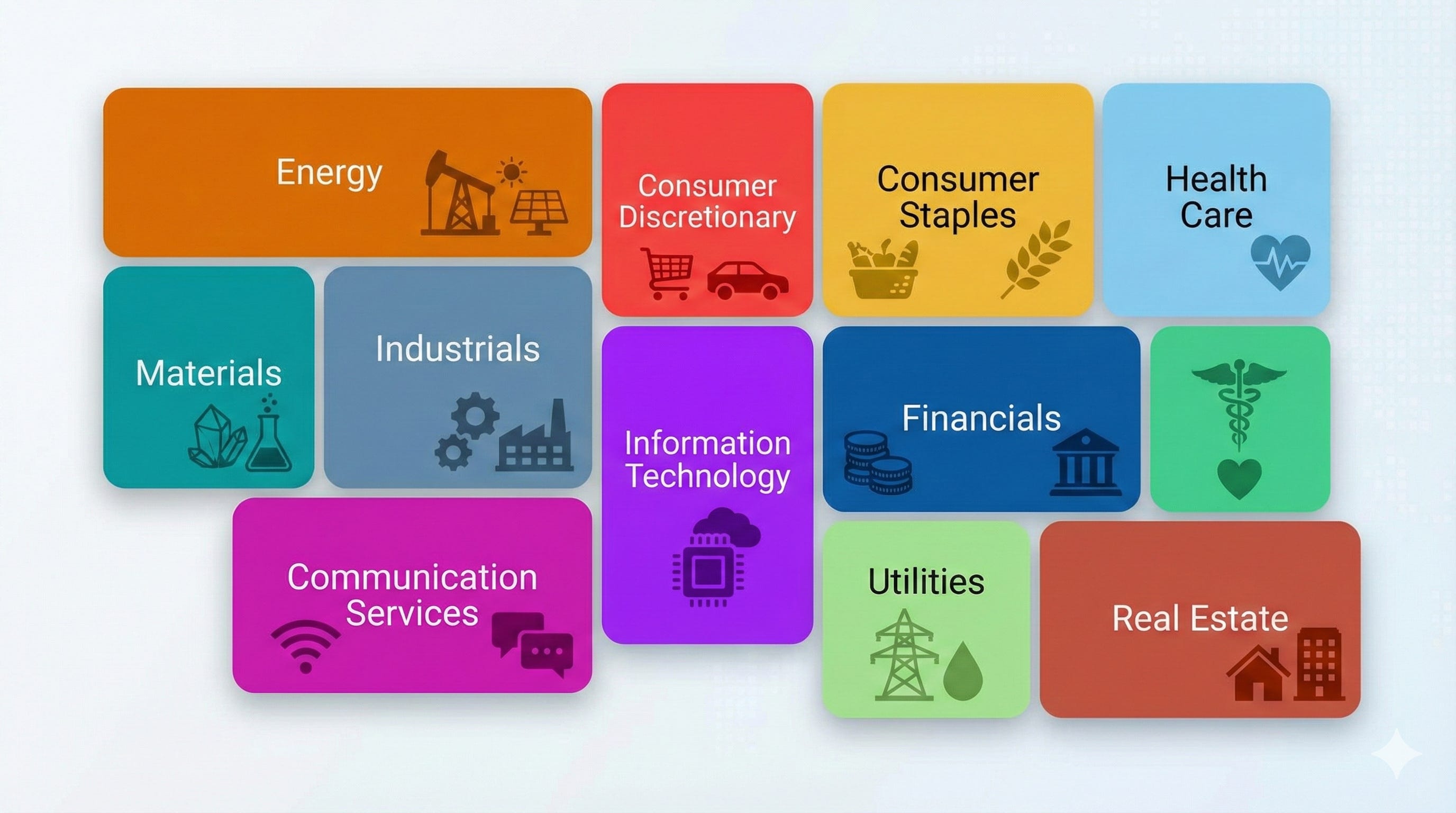
To get a real edge in investment research, its necessary to build deep knowledge across many sectors. Ordinarily this takes decades of experience and many mistakes but thankfully today can be assisted by artificial intelligence. Initially, part of the skepticism surrounding Large Language Models (LLMs) in finance was rooted in the belief that they were generalists with wide, but not particularly deep, domain specific knowledge.
This view is now obsolete however as models, training sets and techniques have become more sophisticated. Through trillion node neural nets, sophisticated fine-tuning and retrieval-augmented generation (RAG), state-of-the-art models are demonstrating deep, accurate, sector specialist financial analysis that gives investors highly useful insights, enables meaningful comparisons across stocks in specialist industries and can distinguish below-the-surface changes in business operations as they occur using industry metrics that gives signals ahead of financials. The caveat is that this is only possible provided the models are fed with the right context and specialist instructions to produce highly specific analysis for each sector or sub-sector.
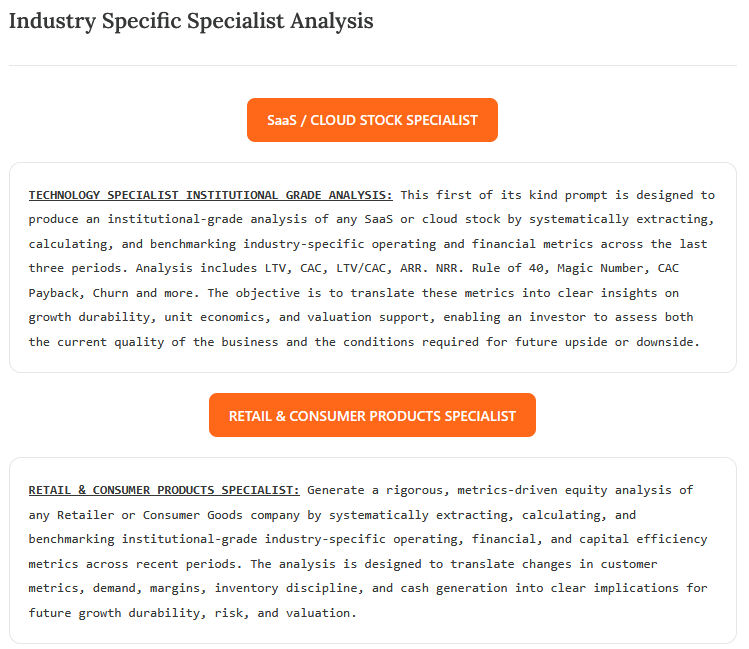
I have launched a new sub section of the Inferential Investor prompt library with sector specialist AI workflows that can utilize this capability to produce highly detailed reports on specialized companies. Starting with Technology / SaaS and Retail / Consumer Products specialists, this section will be built out with workflows for Biotech, Insurance, Banking, Materials, Energy, Manufacturing, E-commerce, Semiconductors etc. As far as I am aware, this is unique.

To understand the extent of the latest generation of LLMs and their sector specialist capabilities, we must look at how these models are trained and then examine how they apply that knowledge to sectors.
Specialist Training
A latest generation LLM’s ability to specialize and excel in finance today is derived from being exposed to curated datasets increasingly specific to individual domains. They have ingested decades of SEC / regulatory filings (10-Ks, 10-Qs, annual reports, prospectuses), that includes as much focus on footnotes and sub disclosure tables as the main financial statements. They have processed many thousands of earnings call transcripts, learning to correlate statements on performance metrics with subsequent stock performance. But crucially, they have also ingested sector-specific trade publications, equity research reports, stock blogs, Fintwit threads and industry specific texts and contextualized distinctions between stocks, industries and the important focal points.
The neural networks record, via their model weights for example, the contextual importance of combined and loss ratios, capital measures and RoE and Price/Book valuations for insurance stocks. The model learns that “churn” carries an elevated weight in a SaaS context that it simply does not carry in the industrials sector and how to make inferences from nuances disclosed in the clinical trial results of a novel drug.
The true test of this specialist capability is seeing how an LLM treats different business models. Less sophisticated or poorly instructed AI models look at revenue and EPS for everyone and do not get below surface level details. This is still true today of even the best models and underscores how important specialized prompts are to unlocking model capabilities that suit the user’s need for detail. This is even more important with the increasing shift to Mixture of Experts (MoE) model architectures (such as Gemini 3) that, for efficiency, only activate sub sections of the model for a particular request. An AI prompted with an instruction set that unlocks areas of the model that have captured specialist context, can synthesizie important industry-specific performance metrics from regulatory information and management statements and interpret relevant insights from that information.
A SaaS example
When analyzing a Software-as-a-Service (SaaS) stock, a contextualized LLM can zero in on unit economics and operational performance metrics below the headline financials. It searches transcripts and reports for Gross and Net Revenue Retention (NRR). It knows that an NRR of 120% indicates healthy upsells to existing clients, a critical driver of long-term value while Gross Revenue Retention provides insights on customer churn rates. Furthermore, the LLM can perform complex synthesis on unstructured data to define customer acquisition efficiency. By analyzing sales and marketing spend against new customer acquisition, it can gauge the Customer Acquisition Cost (CAC) relative to Lifetime Value (LTV). When it comes to valuation, the AI knows that an Enterprise Value-to-Revenue multiple is far more relevant than a Price-to-Earnings (P/E) ratio in this sector. All provided the user specifies a requirement for this detail.
Retailers
Retailers are not seen by investors to be as complex as technology stocks but have their own way of hiding changing performance inside headline financials that requires a a very different approach. LLM’s can recognize and prioritize metrics like Same-Store Sales Growth (SSSg) and Sales per Square Foot to gauge growth and efficiency and compare stocks against these metrics. They can go deeper and also infer that slowing same store sales growth in a retailer that is ramping store growth, where those new stores have a multi-year revenue ramp (that provide an artificial SSSg tailwind), can actually indicate mature stores are already in decline. It can strip away these effects and calculate a mature store SSSg figure. An LLM has the capability to also go deeper on retailer inventory dynamics. It can analyze the relationship between rising inventory levels, management sentiment and Gross Margins. If inventory is up while margins are down and management sentiment wavers, the AI can detect the red flag of impending markdowns.
I have tested these capabilities and seen them in operation. They exist today and are only getting stronger, however these insights will never be surfaced with a 1 paragraph prompt request.
Different Drivers under Different Scenarios
Perhaps the most significant leap forward is AI’s ability to also distinguish which business driver is most critical at a specific point in time. For example, in retail, models can understand that supply chain commentary in a Q3 earnings call is critical due to the upcoming holiday season, whereas the same commentary in Q1 might be less impactful. These are inferences that investors are used to relying on human analysts for, but increasingly can surface via AI.
Try it out
I have spent time building, testing and optimizing deep research workflows for specialist industries starting with Technology / SaaS and Retail Consumer Products industries (linked below). I have tested these across models, noted failure points and differences between quality of output. All are identified on the prompt pages.
As always, all investors can view the specific workflow page that describes what the workflow’s objective is, describes the analysis conducted, review the instructions and preferred model suggestions and see an indicative sample output report. Premium subscribers can access the specific prompt to copy/paste into their chosen AI model.

