


In probably the most reported news globally over the last few days, Jensen Huang, NVIDIA’s founder, resigned as CEO on 12 November 2026, four days after the board opened an independent investigation into reports that he had been the target of a foreign intelligence effort linked to a former Megaspeed executive. Colette Kress becomes interim CEO and keeps the CFO role. Her first public test is the Q3 FY27 results call on 17 November.
The key question for me is: Does this change in leader matter for the NVIDIA’s support of AI financing? In 14 months NVIDIA has become something close to the sector’s bank. It holds a $30B OpenAI stake and has committed up to $10B to Anthropic, part of roughly $50B invested in frontier labs. It has guaranteed lease and power payments for OpenAI’s Ohio campus, capped at $105B. And it has signed MOUs with six alternative-asset managers for financing platforms targeting more than $500B. Huang announced many of these deals himself, often in interviews. For OpenAI, Anthropic, the neoclouds and their lenders, one question now matters most: does the new person running NVIDIA share his appetite?
How I assessed financing appetite
Deal flow alone can’t tell us how willing each executive is to keep financing customers, so I investigated what each one said. I compiled 31 statements on NVIDIA funding its customers’ purchases: 19 from Jensen Huang and 12 from Colette Kress. Each is presented in the Appendix to this piece. They cover November 2024 to November 2026 and come from earnings calls (including analyst Q&A), investor conferences, interviews, CFO commentary and NVIDIA’s essay on the Ohio guarantees.
I used Inferent workflows to score the sentiment conveyed by each statement from 0 to 20 as to the degree to which the statement supports the investments NVIDIA has been making. While it is clear that each executive speaks from a unified corporate message, I was looking for:
Subtle signals in their respective language to suggest if there is a likely change in strategy in the wings due to differences in personal risk appetite; and
Whether Kress’ appetite for further investment has changed over the 2 years (strengthened or faded), based on her language.
The scoring rubric:
• 0–4: retreat
• 5–8: hedging
• 9–11: neutral or disciplined
• 12–15: supportive or defensive
• 16–20: expansive advocacy
Scores reflect each statement in context and are AI calculated. I re-ran every result on verbatim quotes only. For Kress, I compared her last six months (from 13 May 2026) with the prior 18 months as well.
Results
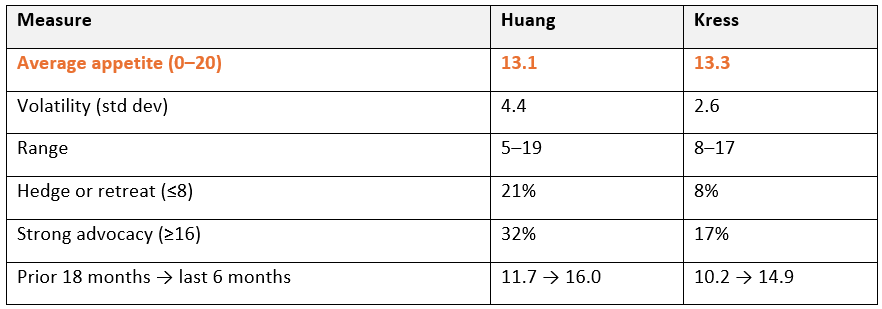
• Highly aligned on message: Comparison of the two averages between Huang and Kress are almost identical, but Huang’s swings were about 70% wider. He produced both the program’s boldest lines and its sharpest retreats.
• Different justifications. Huang argued strategically: ecosystem reach, equity in tomorrow’s hyperscalers, a dollar in for a hundred back. Kress argued financially: the investments are a small fraction of free cash flow, risk is limited, deals are take-or-pay, and third-party capital sits alongside NVIDIA’s.
• Kress has moved toward the program. Her average rose 4.7 points (4.3 on verbatim quotes only), and her volatility fell. In December 2025 she told investors the OpenAI deal still lacked a definitive agreement. By August 2026 she was raising the circular-financing critique in her own prepared remarks and rebutting it. Kress owns these investments now as much as Huang did.
• Main Implication: support continues, with fewer surprise announcements. With Kress coming from the CFO role, its highly likely that any continued activity will reflect more financial and risk restraint that can be justified using conventional risk / return lenses. I’d expect fewer big number deals annunced in interviews, and more capped, structured and diversified arrangements.
Delay risk vs Kress’s evident support
Despite Kress’ evident support for the investment activity NVIDIA has undertaken, the main risk on further AI financing is delays. Two investigations and a new Chairman, could slow any new NVIDIA commitments. The board’s inquiry, run by independent directors with outside counsel, has no published timetable but at the very least is likely to produce policies and committees that provide greater oversight of any arrangements NVIDIA enters into. What was likely once the sole pervue of Jensen Huang to negotiate any deal he wished (given there was no Chairman at NVIDIA), it is probable that decision making will be deferred to committees. Constructing new processes and forming committees takes time. More voices at the table to convince slows activity.
The Department of Justice’s antitrust examination of NVIDIA reportedly covers its acquisitions, investments and sales practices, including whether it pressured customers. The DoJ has also taken over a Commerce Department probe into Megaspeed. With a regulator scrutinising its investments and a CEO search under way, an interim chief has good reason to avoid large new discretionary bets for a time. The reported talks on Anthropic’s IPO (up to $10B as an anchor investor) are the obvious candidate for a pause.
The sentiment record cuts the other way. Kress is not a sceptic waiting for cover to retreat. She built NVIDIA’s public defence of these arrangements, and her tone is at its most supportive and consistent just as she takes charge. The existing guarantees and investments are contractual and don’t depend on who is CEO.
For the AI ecosystem, it is just as well that Anthropic is due to IPO next week and a good outcome may drive OpenAI to follow. These companies can no longer rely on NVIDIA to be there as their bank and guarantor and they can ill afford any financing delays given their cash burn rates.
Conclusion
Huang’s departure removes the founder whose personal conviction drove NVIDIA’s customer financing, but it does not remove that conviction from the C-suite. On the evidence of 31 statements, Kress is at least as supportive of the strategy as Huang on average, far steadier, and more supportive now than at any point in the past two years. The near-term risk is timing, investigation related delays and re-constituting investment policies and procedures at the Board level, not intent.
The board’s investigation, the DoJ’s scrutiny of NVIDIA’s investments and an unresolved CEO search could freeze new mega-commitments for a quarter or two. Contracted support for OpenAI, the financing platforms and the supply chain should stay in place. The stocks most exposed to a pause are those needing new NVIDIA balance-sheet support, such as neoclouds and pre-IPO labs; those relying on existing contracts or third-party capital should feel little change.
Consider pre-registering for the Inferent Analyst App. Agentic Investment Intelligence for all investors from professionals to individuals. Define your watchlist and Inferent monitors for events and presents professional analysis in real time backed by a complete data terminal, and verified financial markets data, news and investor relations materials.
Appendix
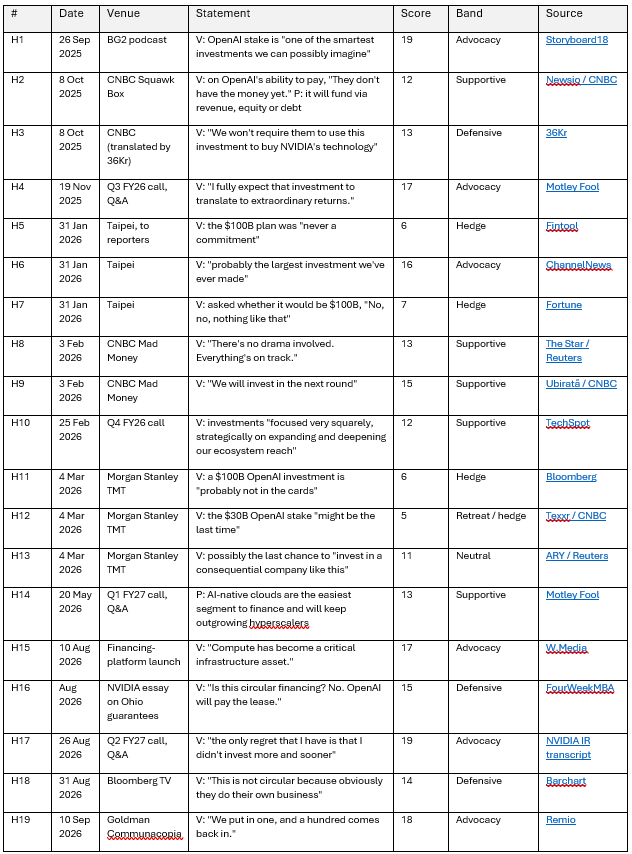
Scores are 0–20 appetite ratings (Inferent workflow AI sentiment analysis). V = verbatim excerpt, P = paraphrase. Excerpts are kept short, one per source document, and full transcripts are linked.
A1. Jensen Huang: statements, sources and ratings
A2. Colette Kress: statements, sources and ratings
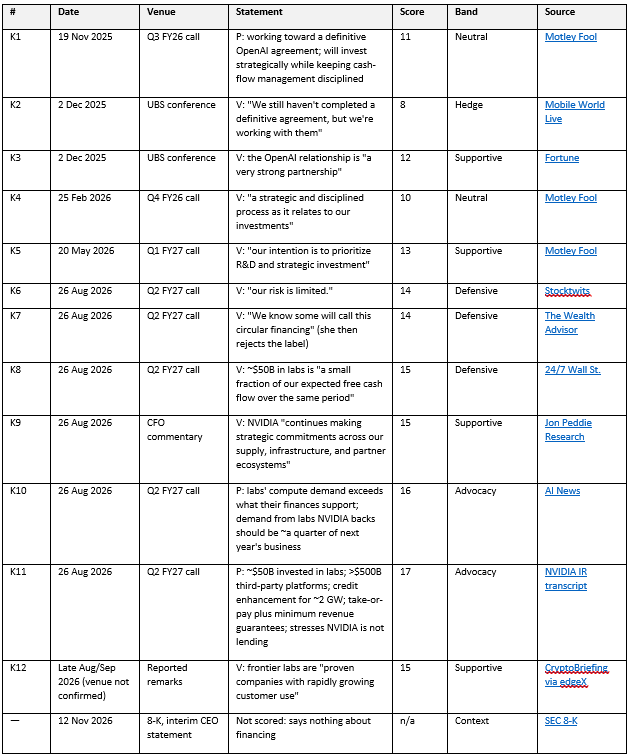
A3. How the sentiment changed over time
