


November 1, 2026
In the last week @InferentAnalyst produced over 600 results and earnings call “Inferent Insights” - concise analysis snippets identifying the new information and must know data points and quotes from US results across sectors. These were all published in real time on our new X account @InferentAnalyst.
From that wealth of new information I then use Inferent workflows to read across companies to identify emergent trends that can be missed if you only look at one or two stocks, but when seen together, reveal how the investment landscape is shifting and where new opportunities may lie.
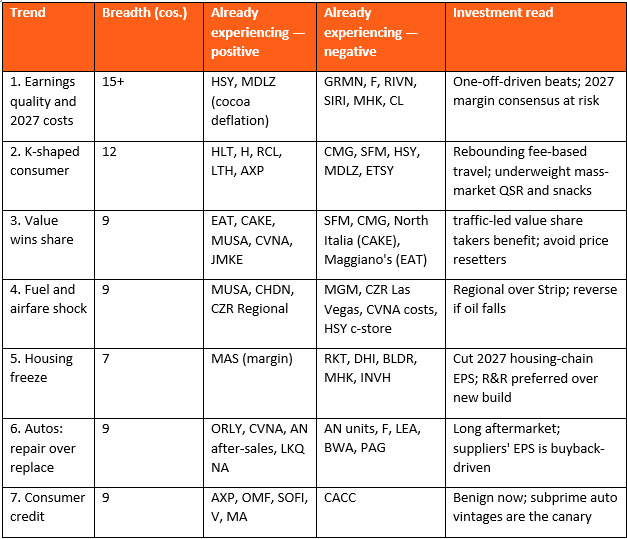
Here I focus on the US consumer – 58 earnings press releases plus 58 earnings calls from last week across consumer discretionary, consumer staples and consumer credit to highlight common threads in these companies’ results. Inferent Analyst identified 7 key themes emerging across companies which I highlight below with supporting quotes and evidence.
Lets dive in…
The US consumer is splitting: Wide spread revenue misses have appeared amongst consumer stocks; while affluent travel and experiences are accelerating into 2027, mass-market food, housing and autos are weakening, and Q3 EPS beats lean on one-offs that will not repeat, with evidence of October softening across certain verticals.
Inferent Key Takeaways
Seven trends recur across 58 consumer discretionary, consumer credit and adjacent staples prints. The macro backdrop is a Fed hiking into a fuel shock with mid-term uncertainty: 30-yr mortgage 7.3%, gasoline above $4.10, crude over $100, and a September rate hike with expectations of more.
• Bifurcation is the dominant signal. Hotels, cruise and premium fitness raised guides; mass-market food, convenience and grocery flagged October softening.
• Value is taking share. Traffic-led casual diners (EAT, CAKE) and low-price operators (MUSA, CVNA) gain; price resetters (SFM, North Italia) sacrifice margin.
• Fuel and airfares are a consumer tax. Fly-to Las Vegas is weak (MGM, CZR) while drive-to regional gaming and HRMs grow.
• Housing is re-freezing into 2027. RKT, DHI, BLDR and MHK all point to lower 2027 volumes.
• Autos: repair beats replace. New and used units fall at dealers; aftermarket, finance and used-car share takers win.
• Credit is not yet the problem. Prime is clean; the first crack is subprime auto (CACC vintage cuts) while lenders accelerate growth.
• Q3 beats are low quality. About 15 names missed revenue but beat EPS on tariff refunds, buybacks and tax; memory, freight and commodity costs re-inflate in 2027.
Trend 1 — Revenue misses emerge; Earnings quality questionable due to one-offs; 2027 costs re-inflate
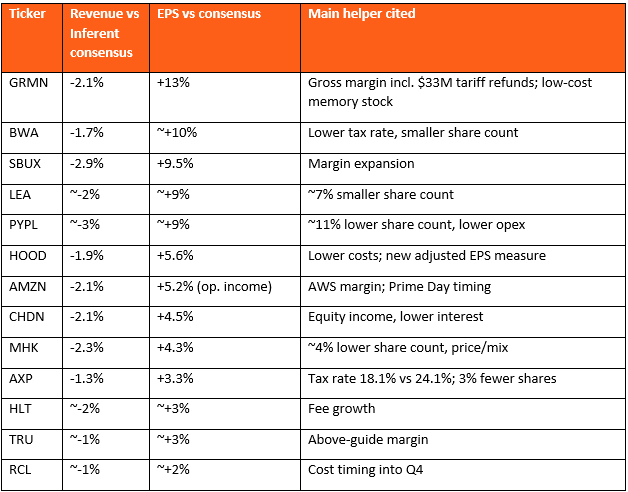
Examine the table below and spot the emerging trend - reviewing one or two stocks will never reveal what’s now appearing after above target inflation, fuel and now rate hikes start to bite. This is the benefit of a system like Inferent that is developing both deep single stock memory but also huge breadth of research across stocks and sectors.
The most common consumer print shape this week was a revenue miss with an EPS beat (13 clean cases below). The revenue/gross profit gap was filled by IEEPA tariff refunds (ORLY $39M, GRMN $33M, HSY $0.22/sh, CROX ~$64M outside adjusted, RIVN, KVUE), lower tax rates (AXP, BWA) and buybacks (PYPL -11% shares, LEA -7%, AN $0.64 of EPS). None of these recur at the same scale.
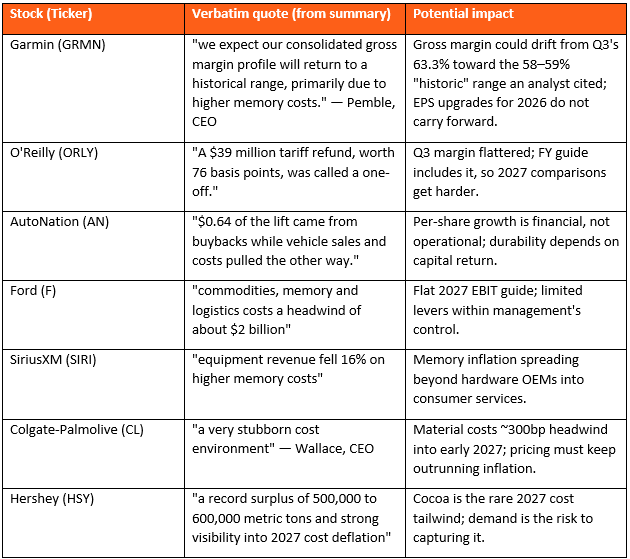
At the same time, 2027 cost bases are re-inflating: memory chips (GRMN, RIVN, SIRI, F), commodities and logistics (F ~$2B), freight and packaging (MDLZ, CL), and mid-single-digit inflation in flooring (MHK). Q3 margins therefore overstate run-rate profitability, and 2027 margin consensus for consumer hardware, autos and durables looks exposed. The counter-trend is cocoa deflation (record surplus cited by HSY and MDLZ), a genuine 2027 gross-margin tailwind for confectionery.
Evidence and impact by stock:
Trend 2 — K-shaped consumer: affluent experiences firm, mass market softening into October
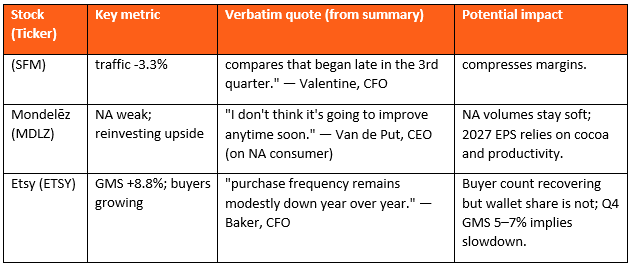
Higher-income, experience-led spend accelerated in Q3 and guides went up. HLT lifted FY RevPAR to 4–4.5% (from 3–3.5%), H lifted to 5.0–5.5% with US RevPAR +8.2%, RCL’s 2027 bookings are up high teens, LTH’s dues rose ~11.9%, and AXP billings grew 8% with write-offs down. At the other end, CMG, HSY, SFM and MDLZ all described a pressured mass-market shopper, with October explicitly worse at CMG and HSY.
The investment implication is dispersion. Fee-based lodging and cruise have 2027 visibility and upward revisions; mass-market QSR, snacks and conventional grocery face Q4 downgrades and margin reinvestment. Single-stock reads miss this: CMG’s October softening “with the broader industry” is confirmed by HSY’s c-store data and SFM’s traffic, while premium names are seeing the opposite.
Don’t forget to pre-register for Inferent Analyst so you can be one of the first to experience the benefits of a natively agentic investment researcher that’s trained to produce deep insights for you on whats happening in markets.

Trend 3 — Value wins share: traffic-led share takers vs price resetters
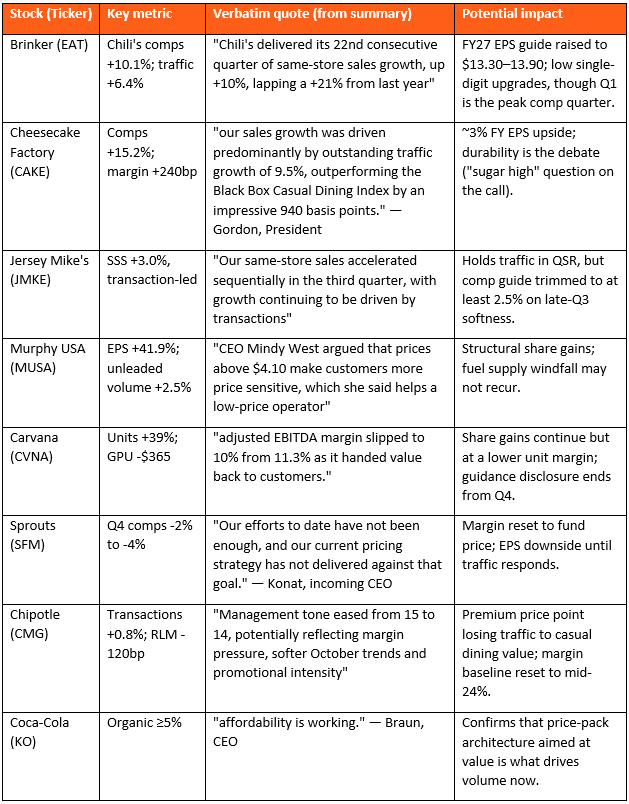
In a flat-volume market, share is moving to whoever offers the clearest value. Chili’s comped +10.1% on traffic +6.4% while lapping +21%; Cheesecake Factory traffic beat the Black Box casual dining index by 940bp; MUSA took fuel share as gas topped $4.10. Laggards are now resetting price: SFM is rolling out national price cuts, North Italia is trialling value pricing, and CMG’s margin fell 120bp amid promotional intensity.
The inflection is that full-service casual dining is out-comping premium fast casual, inverting the recent pattern of fast-casual leadership. Share takers are still paying for it: CVNA handed value back via loan rates (GPU -$365) and SFM’s EBIT guide fell ~11%. Expect wider dispersion, more promotional activity in Q4, and estimate cuts concentrated in brands without a traffic engine.
Trend 4 — Fuel and airfare shock: drive-to beats fly-to
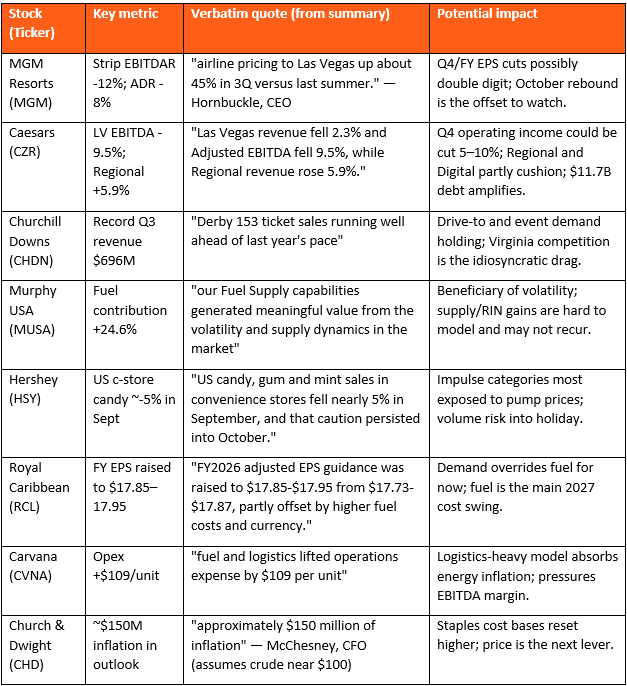
Energy is acting as both a consumer tax and a cost line. Airfares to Las Vegas rose ~45% YoY (MGM), so Strip ADR fell 8% and CZR’s Las Vegas EBITDA fell 9.5%, while CZR Regional revenue rose 5.9% and CHDN’s Kentucky HRMs set records. Fuel also hit costs at RCL, CVNA (+$109/unit) and BLDR (diesel), and HSY saw c-store candy fall ~5% as pump prices crowded out impulse spend.
The cross-company read is a geographic and channel rotation: local, drive-to and low-price-fuel formats gain at the expense of fly-in destinations and convenience-store impulse categories. MGM says recovery “is not fully within management’s control”, so Strip estimates stay at risk until airfares normalize. The trade is reflexive: a fall in crude would unwind MUSA’s windfall and ORLY’s motor-oil inflation while relieving Vegas, cruise fuel and c-store volumes.
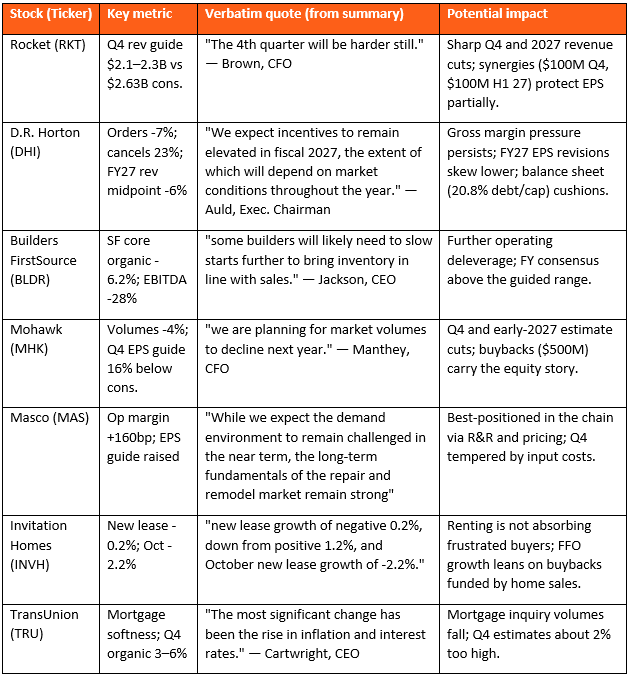
Trend 5 — Rate shock deepens the housing freeze into 2027
With the 30-yr mortgage at 7.3% and rates rising, every link in the housing chain guided to lower 2027 volumes. RKT expects refinance to nearly halve in Q4 and calls it the “toughest mortgage market in more than 30 years”; DHI orders fell 7% with cancellations at 23% and FY27 closings guided below FY26; BLDR expects builders to slow starts; MHK is planning for volume declines next year. Even single-family rental is soft: INVH new-lease rent growth turned negative (October -2.2%).
The implication is a second leg of the housing downturn rather than a 2027 recovery. Earnings are being held up by price/mix, cost-outs and buybacks (MHK, MAS, INVH), which have limited runway if volumes fall again. Consensus 2027 numbers for builders, building products and flooring look high; repair-and-remodel exposure (MAS) is more resilient than new-build exposure (BLDR, DHI).
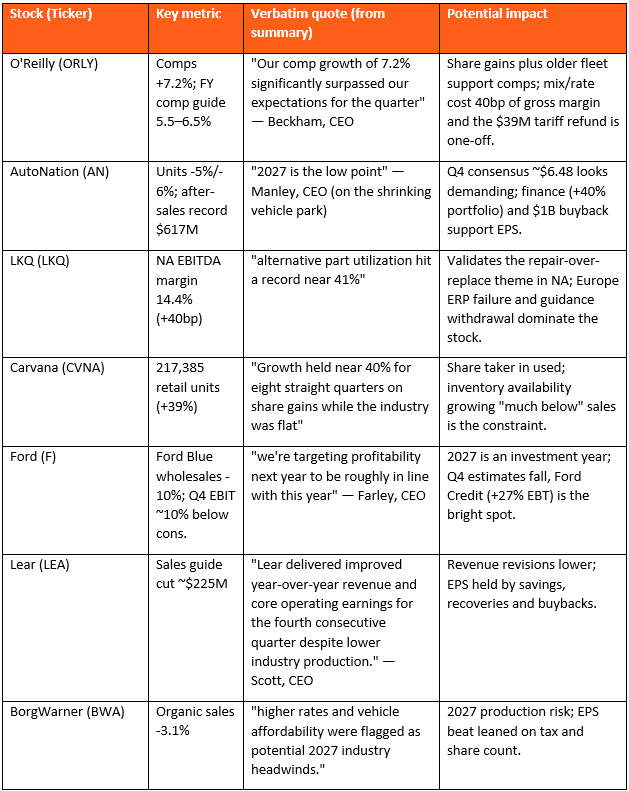
Trend 6 — Autos: repair over replace
Vehicle affordability is pushing consumers to keep and fix cars rather than buy. AN’s same-store new and used units fell 5% and 6%, PAG new units fell 2%, and LEA, BWA and F all cited lower production, while ORLY comped +7.2% with professional up double digits, AN after-sales gross profit hit a record and LKQ North America lifted margin with record alternative-part use (~41%). The one unit-growth outlier is CVNA (+39%), taking used share in a flat market.
For investors this favours aftermarket parts and service over OEM and supplier volume through 2027. Supplier and dealer EPS is increasingly buyback-driven (AN share count -12%, LEA -7%), and F guides 2027 profit flat against a ~$2B commodity, memory and logistics headwind. Two cautions: ORLY’s comp includes ~1pt of motor-oil inflation, and AN flags deferred work and a vehicle-park trough in 2027.
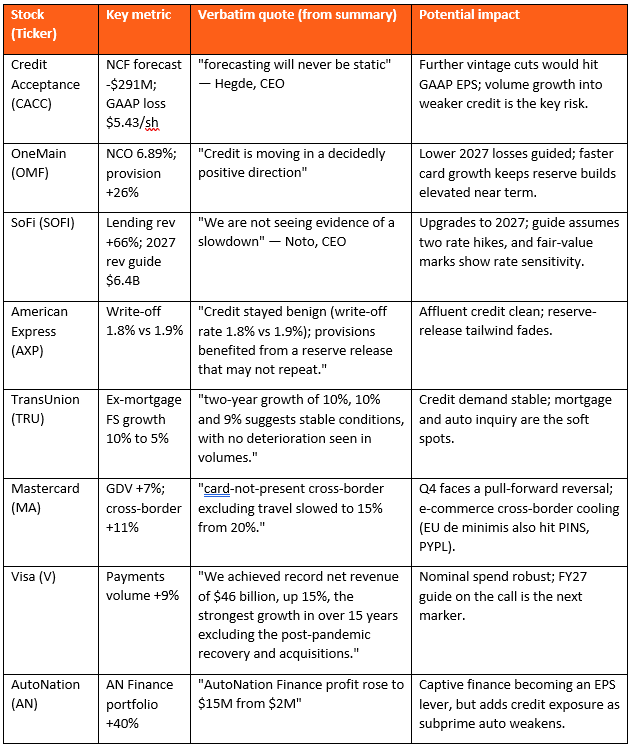
Trend 7 — Consumer credit: prime clean, subprime auto cracking, lenders accelerating
Prime and near-prime credit remains benign. AXP write-offs eased to 1.8%, OMF 30–89 day delinquency fell 12bp YoY and losses are guided lower into 2027, SOFI sees no evidence of a slowdown, and TRU reports no deterioration in volumes. The first crack is deep subprime auto: CACC cut forecast net cash flows by $291M (2.5%) and its 2025 vintage collection forecast fell to 64.9% from 66.9%.
The late-cycle tell is that lenders are leaning into growth as rates rise: CACC units +38%, OMF originations +17% with card units +84%, SOFI lending revenue +66%, AN Finance portfolio +40%. Credit supply is supporting spend now as consumer dis-saving extends, but it raises 2027 loss risk if unemployment turns. Networks (V, MA) look healthy in nominal terms, partly inflation-aided, though MA’s card-not-present cross-border ex-travel slowed to 15% from 20%.
How these trends potentially play out
The emerging base case is a higher probability of a weaker mass-market holiday and a Q4 estimate-cut cycle, while affluent travel keeps compounding into 2027 absent a material equity market swoon. The upside risk factor to this view is a potential rebound in consumer confidence after mid-terms and/or a fall in crude.
Q4 guides already sit below consensus at AMZN, RCL, HLT, F, BLDR, MHK, LTH, LAUR, TRU, ETSY and RKT, and October softening at CMG, HSY and SFM suggests restaurant and snack numbers have further to fall. If the Fed keeps hiking into $100+ oil, the housing and auto legs potentially deepen and subprime auto weakening could see broadening from CACC to other lenders. A fall in crude is the main upside risk, relieving fuel-taxed consumers, Las Vegas and cruise costs at once. However we also cannot rule out a rebound in consumer confidence depending on the mid-term outcomes. Its reasonable with this base case to expect EPS dispersion to widen from here. I’ve deliberately tried to get through this research note with as few mentions of AI as possible!
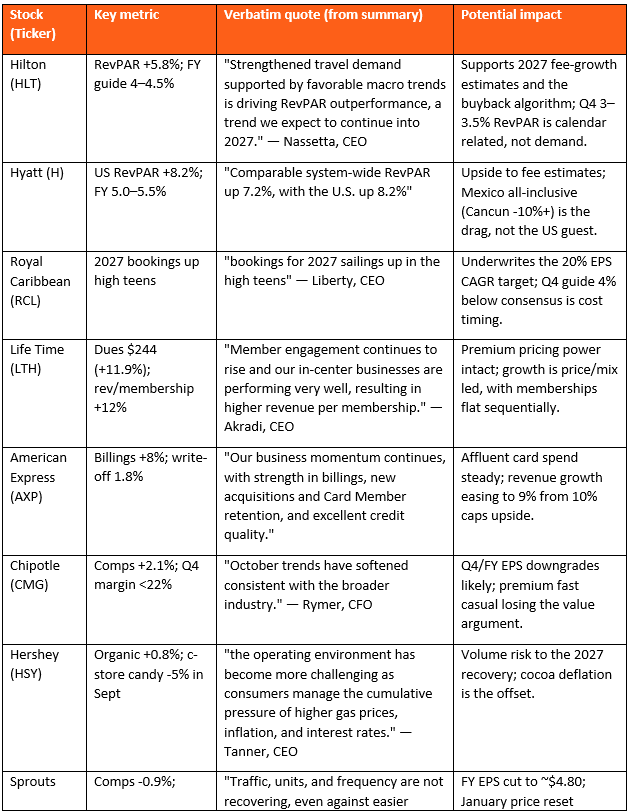
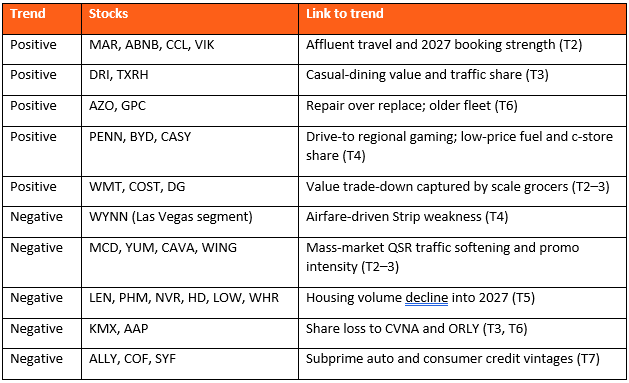
Read-throughs to stocks not yet reported:
The following table identifies related stocks that are still to update the market. Information transfer from these trends may be expected to also show up in:
Coverage and data
• Universe (58 consumer companies, reported 23–30 Oct 2026): Consumer Discretionary (33): AMZN, AN, BWA, CAKE, CHDN, CMG, CROX, CVNA, CZR, DHI, EAT, EBAY, ETSY, F, GRMN, H, HLT, JMKE, LAUR, LEA, LKQ, LTH, MGM, MHK, MUSA, NCLH, ORLY, PAG, RCL, RIVN, SBUX, SCI, VFC. Consumer credit and payments (11): AXP, AX, CACC, HOOD, MA, OMF, PYPL, RKT, SOFI, TRU, V. Housing-linked (3): BLDR, INVH, MAS. Staples and media for consumer colour (11): CHD, CL, HSY, KO, KVUE, MDLZ, PINS, PSMT, RBLX, SFM, SIRI.
• Source: Inferent earnings and call summaries. Quotes are verbatim from those summaries; some are summary text rather than management words, attributed only where the summary names the speaker.
• Estimated vs sourced: Surprise percentages are as stated in the summaries (”~” where rounded); The breadth counts in the summary table and the “Other stocks likely affected” list are judgement, subject to risk and uncertainty and are not forecasts.
Andy West
The Inferential Investor

Important Disclaimer: The following stock discussion and analysis is subject to The Inferential Investor’s Disclaimer. This article is for informational and educational purposes only and does not constitute financial product advice or a recommendation to buy or sell any financial product or security. It has been prepared without taking into account any individual’s investment objectives, financial situation, or particular needs. Past performance is not a reliable indicator of future performance. All forward-looking statements are scenario-based assessments and not forecasts or investment recommendations. Recipients should seek independent professional financial advice before making any investment decision. AI can make mistakes and information should be independently verified.